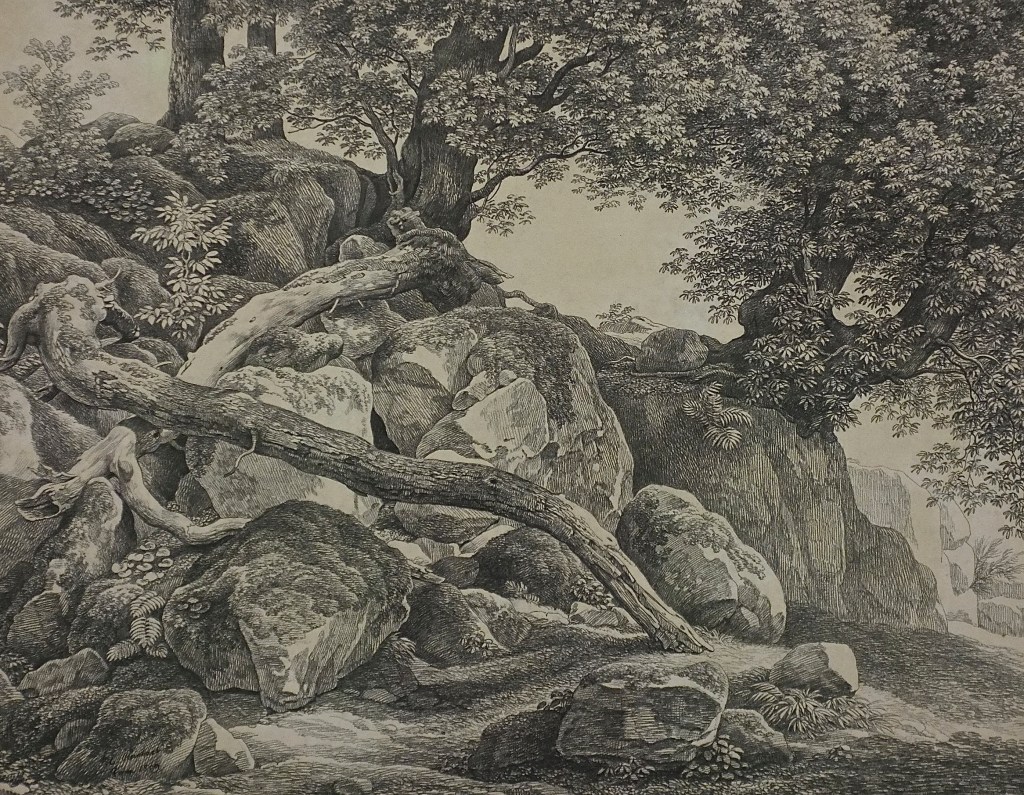
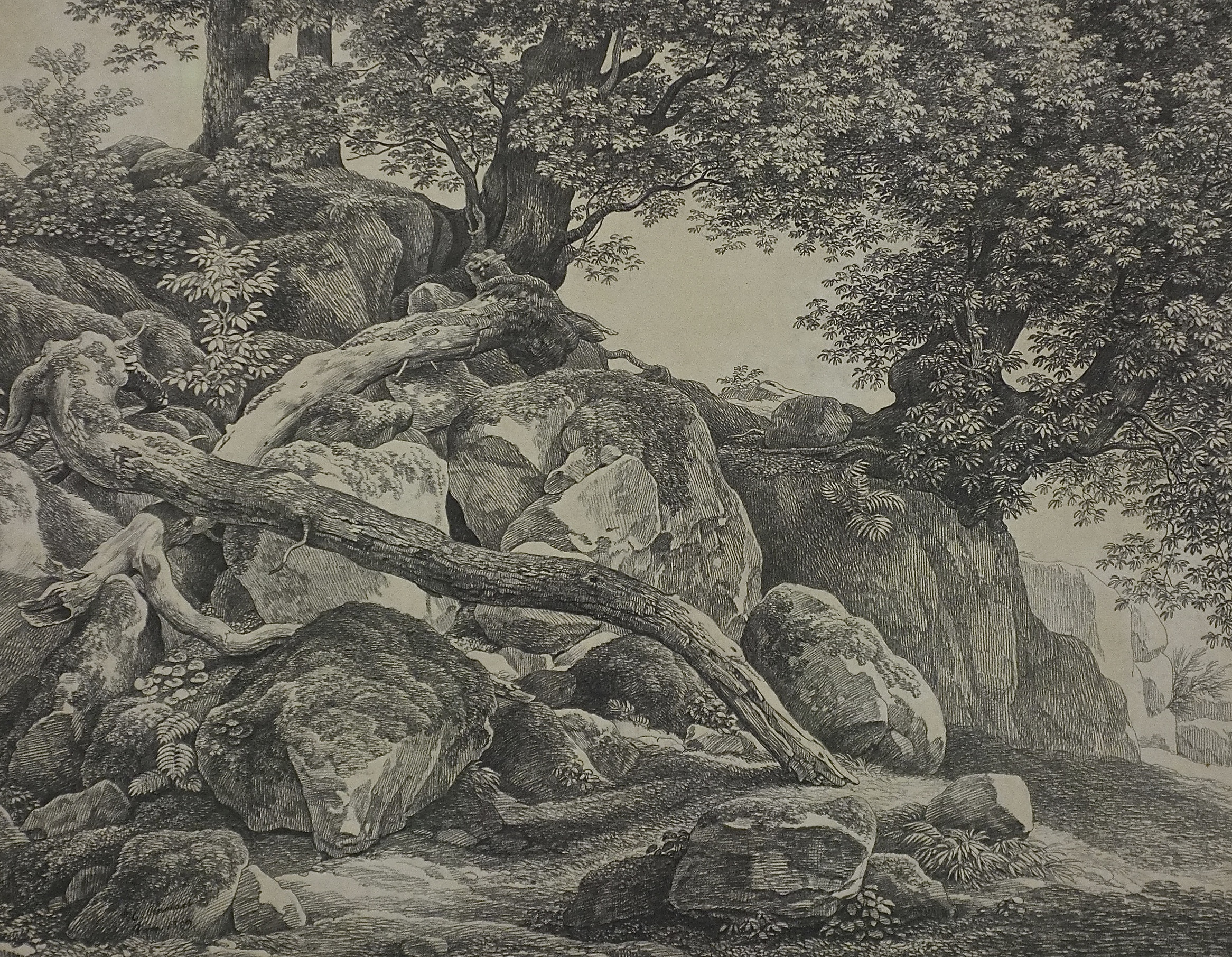
How do you begin a conversation with a stranger in a museum? At the Neue Pinakothek in Munich, in a gallery of sketches and etchings by Johann Christian Reinhart, I had photographed a detailed pencil sketch of a clump of trees and rocks when a woman came up.
“Will you take these photos back to India?”
We had seen each other a minute ago, smiling briefly as we crossed, she on her regular round, I on my way to Reinhart’s years in Italy.
“No,” I said. “I live in Germany.”
“Ah, you live in Germany. Where do you come from?”
“India.”
“India yes. But where in India?”
A short woman in a blue suit, she had Maggie Smith’s eyes and Charlotte Rampling’s lips. About sixty, very attractive. Perhaps it was the way she held herself, a manner that suggested she wasn’t a museum guard but an actor in that role.
“Bangalore.”
She hadn’t heard of the city. “Is it near Delhi? Calcutta?”
“It’s in the south.”
“A girlfriend of mine goes to India each year and spends few months there, traveling. She has seen cities in the north — Delhi, Agra, Calcutta. She is in India now, and she’s back tomorrow!” Her eyes glowed.
“Have you visited India?”
“No, I haven’t.” She pointed to her knees, shaking her head. “My feet cannot bear a long flight.” Then, after a moment’s hesitation: “But I would love to. It is a very interesting place, and Indians are very nice people.” She smiled.
“Yes, a very interesting place. Your English is good.” Few elderly Germans speak good English, and I was curious.
“Ah, I was in London many years ago, to learn English, among other things. I met many Indians there, and Pakistanis, and Africans. It was fascinating.”
I chuckled hearing her place Africans with Indians and Pakistanis. A friend of mine from Nigeria may have said to her, Africa is not a country.
I said: “London is a multicultural city.”
“Cosmopolitan, yes. Where do you live in Germany?”
“Near Heidelberg.”
“Have you been here long?”
“About twelve years now.”
“That’s a long time. Do you intend to stay or will you return?”
They always ask that. It is an innocent question to ask, a heavy question to receive.
“I’ll return.”
“Really?” She raised her eyebrows.
“Yes. Definitely.”
She smiled. “I wish you a good time here.”
“Thank you. It was nice talking to you.”
* * *
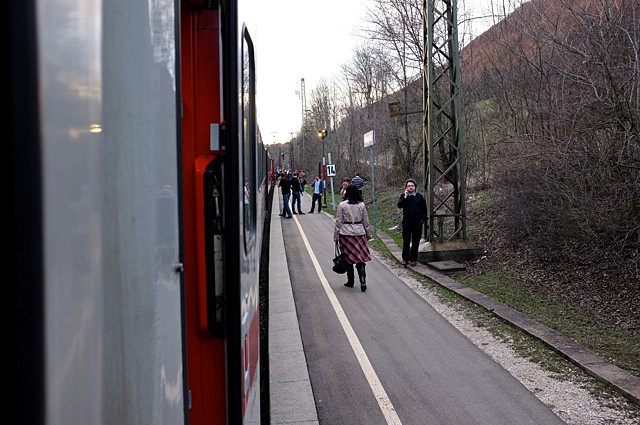
On the EC 216 back from Munich I sat next to a young woman, about twenty years old, immersed in sheets of typed paper like a girl busy with homework. Conversation seemed a possibility, but her concentration, intense and unvarying, was untouchable. Then, half an hour from Stuttgart, the train stopped. A breakdown in the line ahead, the announcement in German said, and there was no saying when services would resume. People stepped off the train. I followed, camera in hand. It was chilly outside. The sun was sinking behind rolling meadows. We were next to a small hill with a unpaved path circling it. One or two were walking up this path, others were hanging around the train, smoking, chatting, speaking on the phone, typing on the phone. I took some pictures and returned to my seat.
The woman was on the phone. A round face, rosy cheeks, blond hair parted in the middle. Her German was accented, and she had the chirpiness of a teenager. When she finished with the phone, I turned to her.
“Traveling to Stuttgart?”
“Yes. I’m visiting a friend for the weekend.”
“You’ll be late now.”
“I know!” she smiled. “I asked my friend not to come to the station.”
“Is that Polish you are reading?”
“Yes. Actually I’m translating Polish into German. I work as a translator.”
“What a coincidence! The book I’m reading is about translation.” I showed her the cover of Is That a Fish in Your Ear, by David Bellos.
She looked at the book. Then she nodded.
“I picked it up at Munich, and so far it’s very good. Right now I’m reading a chapter on why the English word ‘translation’ is inadequate, or perhaps even inappropriate, for the meaning it tries to convey.”
My mind was on the thrilling paragraph I had read on the richness of Japanese language:
If the translation we are discussing is complete, we might call it a 全訳 zen’yaku or a 完訳 kan’yaku. A first translation is a 初訳 shoyaku. A retranslation is a 改訳 kaiyaku, and the new translation is a 新訳 shin’yaku that replaces the old translation, or 旧訳 kyū yaku. A translation of a translation is a 重訳 jū yaku. A standard translation that seems unlikely to be replaced is a 定訳 teiyaku; equally unlikely to be replaced is a 名訳 meiyaku, or ‘celebrated translation’. When a celebrated translator speaks of her own work, she may disparage it as 拙訳 setsuyaku, ‘clumsy translation’, i.e. ‘my own translation’, which is not to be confused with a genuinely bad translation, disparaged as a 駄訳 dayaku or an 悪訳 akuyaku. A co-translation is a 共訳 kyō yaku or 合訳 gō yaku; a draft translation, or 下訳 shitayaku, may be polished through a process of ‘supervising translation’, or 監訳 kan’yaku, without it becoming a kyō yaku or gō yaku. Translations are given different names depending on the approach they take to the original: they can be 直訳 chokuyaku (literally ‘direct translation’), 逐語訳 chikugoyaku (‘word for word translation’), 意訳 iyaku (‘sense translation’), 対訳 taiyaku (‘translation presented with the original text on facing pages’), or in the case of translations of works by Sidney Sheldon, Danielle Steel, John Grisham and other popular American writers, 超訳 chōyaku (‘translations that are even better than the originals’, an invention and registered trademark of the Academy Press).
I would have liked to read it aloud to her, to hear the sounds of those Japanese words, but she did not show interest in the book. For someone who worked with language, I found this surprising. Perhaps more disappointing than surprising.
“What kind of translation do you do?”
“Oh, boring technical manuals, contracts, and things like that. If the original is well written, the translation is easier. Otherwise it can be hard.” She frowned, looking down at her papers.
An announcement came on air. The train was to start soon, and arrive in Stuttgart half an hour behind schedule.
“I need to check when my next connection leaves.” She pulled out the smartphone from her handbag.
There is an app for every situation.
“Do you have to wait long?”
“I can take the eight fifty-two, so that’s fine” she said.
Night was setting in. The train began to glide, and soon the windows reflected a brightly lit compartment. She had returned to her papers. I opened my book.


 Parmanu