Ugly witches and a little mouse


Last December my eight-year old nephew visited us from the U.S. It was his first trip to Germany, his first long vacation away from home in many years, and his eagerness to get here was matched by our enthusiasm to prepare for his visit. Wife and I planned and emailed him a ten-day itinerary, full of events and day-trips and guided tours for kids, to which he replied with a request, politely phrased, for more time at home. We guessed why — home was ideal for playing games on his Nintendo DS — but it turned out that there was more to it than video games.

The boy is a reader. In his ten days here he read as many books and finished half my collection of the complete Tintin series. When I told him how happy I was to see him read, he thanked me with a wide smile and added that last year, in his second grade, he had read a hundred and seventy five books, just twenty five short of the mark the school had set for the first prize, an iPod. No one had won it, but he seemed confident to reach the goal this year.

Continue reading “Ugly witches and a little mouse”

That winter


That winter, the mildest in a long time, comes back to me now with the clarity of a cloudless sky. Not only was it mild, the winter also began late. In the second half of October, when the temperature finally slid into single digits, Jörg, a colleague at work, observed that the late onset portended a harsh winter. Expect spring to arrive late, he added. A harsh winter, and a late spring. Every following week proved him wrong. Mid-November the sun shone as though we were in the southern hemisphere, T-shirts and short skirts were everywhere on the streets, and people who wore them walked past shopfronts that stubbornly continued to display winter wear, waiting, like Jörg, for that cold wave to cover Europe in an icy blanket. The blanket appeared, grey and cottony, but it brought only rain, a version so mild that in the final of the local football league people sat without umbrellas watching SV Sandhausen beat FC Ingolstadt 2-1. When it snowed, around the 20th of December, there was a collective sigh of relief, on the radio, in the papers, and even from the alte Frau at the bakery who could not suppress an “Endlich!” as she handed me the Mohnbrötchen with one hand and pointed to the snow with the other. It was as though the prayers of an entire nation had been answered. The mood lifted, from despair and talk of a global-warming induced apocalypse, to hope and even a firm belief in a white Christmas that year. The Gods must be punishing us for our arrogance, the neighbour downstairs noted the following day, when it rained so hard that in a few hours the streets were scrubbed clean of all whiteness. Earth’s magnetic poles must be reversing, Jörg said, when I ran into him at the local Penny Markt on the morning of the 24th, before stores closed for the long weekend. He had studied physics in his younger days, even pursued his doctorate in superconductivity before falling prey to a notion — one he still clung to — that the way to explain gravity, the only force still beyond the full grasp of physicists, was through magnetism. The gravity of planets could be measured, he believed, through the interplay between their magnetic fields and the cosmic radiation that filled most of the universe. Following many years of solitary research, spent trying to prove this hypothesis after the scientific community had distanced itself from his ideas, he abandoned the attempt and left physics altogether. I understood little of his theories, and said so, but this did not affect his inclination to speak his mind. The magnetic poles of the earth switch every half a million years, he said, clutching his overloaded grocery bag, and it was almost time for the next reversal. He added that this was scientific fact, not one of his theories, and that no one could predict the effects of the transition, which could last from a few decades to a few centuries. Birds could go crazy finding their way, our compasses would stop working, and the northern lights, aurora borealis, may appear anywhere above the earth. Its effects on weather were the least understood, and what we were witnessing was only the beginning. If we survived this period, he concluded, in a somber tone, we may even find our seasons switched: December would bring with it the height of summer, and it would snow in June and July.

Continue reading “That winter”

Year-end musings


In the last ten years or so the Christmas and New Year week has, for us, acquired a particular significance, shaped by a culture-driven consciousness that this is a period of renewal, a time to take stock of the year gone past and to prepare for the new one ahead. Renewal, old giving way to new, is conveyed through a total shut down of commerce (workplaces are empty; business slows to almost a halt; stores are closed from the afternoon of 24th until the 27th morning, and if you do not stock up earlier only the kindness of neighbours or friends can save you), and all the year-end lists in magazines and newspapers send home, unequivocally, the message that this is a changeover period. In all, a sense of ending, an intimation of a beginning.

Continue reading “Year-end musings”

Being and foreignness


For the first time in history, across much of the world, to be foreign is a perfectly normal condition.” — The Economist, December 17th 2009


1.

The Weihnachtsmarkt in this town was a small affair. It began at the western end of Hauptstrasse, with a stall selling dry fruits and nuts, and continued up the street, extending partly into the neighbouring Marktstrasse or Blumenstrasse, and ended at the eastern perimeter less than a kilometer from the start. The stalls, small log cabins with pine sprigs and yellowish light bulbs strung across their roof angles, displayed the usual wares: chocolates and gummy bears, gluh wine, crepes, potato pancakes, bratwurst & schnitzel, christmas-tree knickknacks, and ceramic crockery. At the intersection of Marktstrasse and Höllgasse there was a small carousel, manually operated, with eight horse-shaped mounts each painted a different colour. Not far from it stood a märchenzelt, a fairy-tale tent, white and round with a conical top, glowing like a dimly lit bulb. This tent was where I was headed, with Wife and some friends, on a cold and overcast November evening not long ago.

The evening’s plan was simple but unusual: from 7 to 8 P.M. children visiting the tent would be read Indian stories in German by a few Indian ladies. Wife, one of the storytellers, had made me a target of her daily practice sessions the previous week. The story she had chosen (“Sukeshini and the lake demon”) was about an Indian girl who tricks a demon and brings water to a drought-stricken village; she had translated it into German with the help of a friend. Others had chosen similar stories, Indian folk tales translated into German.

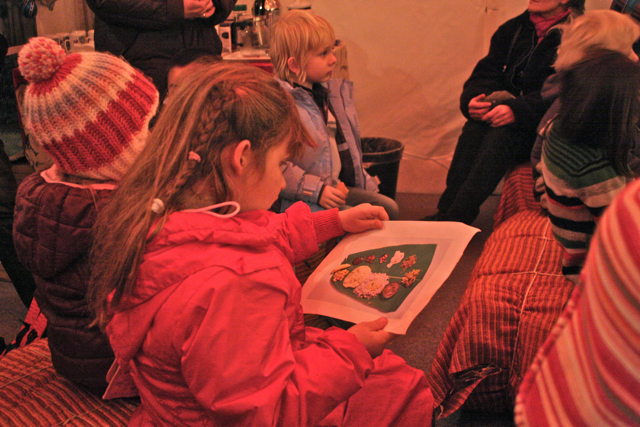
Inside the märchenzelt six or seven boys and girls sat facing a middle-aged woman reading a German fairy tale. At 7 P.M. the Indian ladies, dressed in colourful sarees or salwar kameez, started the session with a Namaste. “This is how you greet people in India,” one of them explained. The children mimicked the gesture and giggled. Then the stories were read out loud, one after another, each storyteller pausing in places to ask a question or to explain the context. Some of this context was presented as illustrations: colour printouts of scenes from the story — taken from the original storybook — or of an Indian situation or custom, like a festival or a feast served on banana leaves. The kids looked at the copied illustration before passing it on, and occasionally a curious parent leaned over their tiny shoulders for a quick glance. In the middle of the hour, after a couple of stories, the ladies sang a nursery rhyme in Hindi. The boys and girls were asked to repeat, line after line:

Haathi Raja bahut bade
Sund utha kar kahan chale
Mere ghar mein aaon na
Halwa puri khaon na
Aaon baitho kursi par
Kursi boli chatar-pattar!

The parents joined the children in this recitation. It was a charming reversal, with the Germans attempting what the Indians had been doing so far: speak in a foreign tongue.


At the hour’s end the children sang the rhyme once more, said Namaste, and left. Outside a slight drizzle had begun; we picked up some gluh-wine and crepes and stood chatting under the awning of an electronic store, next to its brightly lit windows. The store appeared closed, but soon a man approached us, with the obvious intention of entering it. Middle-aged, huge and bald and white like a WWF wrestler, he stopped in front of me and asked, with a half-smile: “Darf ich?” May I?

Continue reading “Being and foreignness”

The politics of foreignness


[Part 3 of the Interpretations series.]


This is not a good time to be foreign.” — The Economist, November 19th 2011


Earlier this month, xenophobia again grabbed the headlines in Germany. Investigations following the arrest of a woman, one of three members of the “National Socialist Underground” group, revealed that they had killed nine people between 2000 and 2006, and injured many more with a bomb in 2004; eight of the nine killed and most of those injured were of Turkish origin. Until this recent discovery, none of these hate crimes against foreigners were linked to the neo-Nazi group. (Suspicions were directed instead at the Turkish mafia.) The news caused the Germans embarrassment, shame, and regret, in that order. Media uproar followed, and the issue reached the parliament. Chancellor Angela Merkel called it a “Disgrace”. Politicians renewed their call for a ban on the far-right National Democratic Party (NPD). On the 22nd, two weeks after the sensational discovery, the parliament issued a joint statement that began: ”We are deeply ashamed…”

Continue reading “The politics of foreignness”

An Indian in Germany


[Part 2 of the Interpretations series, which began here.]


In the winter of 2000, a few weeks before we left India for Germany, Wife and I were invited by a relative for a farewell lunch. This uncle and aunt were encouraging and optimistic about our plans to migrate (“At least you aren’t going to the U.S. like the rest of them,” they said), but the aunt’s father, an elderly man with hawk eyes, took a different view. “Why are you going to Germany?” he asked. “It is the most racist country in the world, don’t you know? Haven’t you read about Hitler and the Jews? The Germans hate foreigners — I would think ten times before going there.”

Continue reading “An Indian in Germany”

Interpretations


The other day, while waiting at the doctor’s reception, I witnessed a dialogue between a black man and a white woman that left me thoughtful and gloomy.

* * *

On this day there is a long queue, unusual for this place, and the German woman behind the reception desk is not in a friendly mood. She is a young woman, wearing a white shirt over white pants, her blond hair pulled back in a short pony-tail. She is efficient in the way Germans usually are: doing the job with precision and speed, assuming a polite but firm manner. But she also seems disturbed, not at ease: she moves her hands rapidly, avoiding eye-contact with the patient in front, which lends her a distracted, impatient air. She deals with a couple of patients in this manner, and then it is the turn of the black man two places ahead of me.

From behind, and from the occasional glimpses of his profile, he resembles the actor Morgan Freeman: an elderly man, tall and heavy-set, curly greying hair, a pockmarked face with deep lines on his forehead. I imagine him speak in a clear, intense voice, but what comes out is hushed and hesitant: German is foreign to him, and he is struggling.

“Ihre Telefonnummer, bitte?” the woman asks, looking into her computer screen.

Continue reading “Interpretations”

My problem with The Cat’s Table


My first acquaintance with Michael Ondaatje’s The Cat’s Table was through an extract published this spring in The New Yorker. Reading it, I felt like an eleven-year-old watching a magician pull a rabbit out of his hat. I wanted to see more. The book, I learned, would be published “in summer”.

Summer arrived early, but the publishers kept their date fixed not to the season but to the calender. The weekend before the book’s release I scanned some reviews, avoiding parts that revealed the book’s contents, looking for whiffs of judgement. Everyone seemed to love it. On the day of its release, the Kindle edition on Amazon was prized at $3.50. Could this be true? For the price of two ice-cream scoops I could buy a new novel from a contemporary master of fiction? And it would be delivered instantly?

* * *

I do not own a Kindle, but the iPad at home has a Kindle App that lets me read Kindle eBooks on the iPad.

Let this be an experiment, I told myself, as I greedily purchased The Cat’s Table, Kindle Edition. Perhaps this would mark my transition into the world of eBooks, a step I had avoided this far.

* * *

Months later, I am still at “location” – the Kindle analog for “Page” – 235 of 3525. And I’m struggling to understand why.

* * *

Continue reading “My problem with The Cat’s Table”