US Diary

1. Frankfurt – Newark

After security at the Frankfurt airport, in an Italian restaurant with a fine selection on the menu, the American family seated nearby ordered burgers and coke. We also overheard bits of their conversation. (This was easy: they were loud.) At one point the father, a bald man with a wrestler’s physique, looked at a TV on the wall displaying news of Obama’s visit to Germany and said, “History will judge Obama as one of our worst presidents, just you wait and watch.” His son, a lanky teenager sitting opposite, began to protest, but was promptly put down. Biting into his large hamburger, the father said, “The burger’s good, don’t ya think?”

Near the gate came further intimations. The ladies restroom my wife entered had only a single cabin, which was locked. As she exited a large white woman standing nearby spoke: “I’ve been waiting outside, excuse me!” No one could have known this before entering the restroom, but my wife was too stunned to respond. Then, another woman sitting a little away came up and said, “I’ve been waiting too!” This woman’s accent also was American, and (my wife concluded) so was her attitude. In the moments of emotion that follow an unpleasant social encounter, my wife and I agreed that people of that country seem to carry a sense of entitlement wherever they go. Displaying this inside the US was bad manners; outside, it was comical. My wife wondered if we would visit the US if her parents were not living in the country. Probably not, I said.

Not a propitious beginning to a three week vacation in the US. But things only got better from here.

Continue reading “US Diary”

Yeh Jawaani Hai Deewani


Yeh-Jawaani-Hai-Deewani

I arrived in the US ten days ago. After a trip to LA and San Diego (visiting theme parks with my ten-year-old nephew R.), I’m back in New Jersey, with my in-laws. Yesterday we visited a local cinema for a Hindi movie.

This is not new, and it must be common experience for New Jerseyians, but it never fails to amaze me. The queue behind the ticket counter is packed with only Indians. About thirty of them. Lined up for Hindi and Telugu movies. Yeh Jawaani hai Deewani, Ghanchakkar, Raanjhanna, Balupu. Some are in Indian clothes, salwaar-kameez or kurtas. They speak in the vernacular, one or two with an American accent.

The movie we watch, Yeh Jawaani Hai Dewaani, is a modern love story. Boy meets girl on a trek; they like each other, but the boy has ambitions — plans to see the world, to seek adventure; they move on, but eight years later they meet again; old love surfaces, so does the old conflict; the boy has to choose between his desire for adventure and the rootedness of family-life; he chooses the girl.

What made this story different from a Hindi movie from the eighties or nineties is the absence of family in the narrative. Parents appear at the beginning, before boy and girl leave home, and the boy briefly remembers his father near the film’s end — for the rest boy and girl are independent, making choices and living by them. Compare this to QSQT or DDLJ or Lamhe. Family used to played a large role in love stories — is the new trend a reflection of urban India today?

The other difference is the film’s attitude toward the West. Going abroad still has its charm, and the boy does spend time in Europe (even kissing, in the space of a song, a striking blonde, something I haven’t managed in twelve years there), but in the end he returns. New York and LA and Paris are good, but the future is back home. This is the confidence of a new India.

The Echo

Konigsee


Every once in a while, recalling a distant memory, what you remember is shot through with such brilliance that you can relive the experience, invoking each time the scene in its original intensity. There was such a scene during our Easter vacation that April, a moment of sublime beauty mid-way on a boat ride in Königsee.

Königsee: long, narrow, winding, and hemmed in by steep, rocky mountains, the lake feels like a fjord. They say the lake was formed by a glacier in the last ice age. There is a remoteness to it, a timeless atmosphere. On a quiet day, looking up at the uninhabited slopes around, one can imagine a time no humans walked the earth.

Water touches rocks on all sides, steep edges keep the perimeter inaccessible by road: only a boat can ferry you from one point to another. We were on such a boat, oblong, wood-paneled, driven by electric motors that leave the turquoise blue water unpolluted. The boat was full. Adults clicking photos, children running about, mothers behind them: solitude was unattainable. The tour guide, a grey-haired man with a moustache, spoke through a microphone, his voice betraying a boredom that accrues from repeating jokes a dozen times each day. In the middle of his routine, when we expected another of his quips, he announced that he would now play the flugelhorn, a trumpet-like instrument. The lake was known for its echo, he said, but few were privy to the real source of the echo: his twin, up on the mountain, parroting the notes that rose from the bowels of Königsee. We laughed. He lifted the instrument out of a black leather case, well-worn but elegant. Windows on both sides of the boat were opened, and a hush descended in anticipation. I heard gentle waves lap the sides. A seagull shrieked somewhere. Cold air clipped my ears. The blue-green lake merged with shoreline grey. For a few seconds the silence was total. Then he began to blow. Four notes, barely musical: tra la ra laaa. When he ended, and before the notes trailed off, we heard a distant yet startlingly clear echo, a mirror image of the notes he had played. He blew again, carrying on the tune, and the echo followed, like an obedient pupil following the master. The echo reached us as he finished each sequence, the repetition took off just as the original faded.

And I imagined a figure up in the mountains, in a conical cap and a clown’s cape, running around pines blowing a flugelhorn to match his twin below, laughing at the trick they played on the tourists.

Mont Saint-Michel


MontSaintMichel


In the end, a small stretch of water between the mainland and the island of Mont Saint-Michel turned for us into a gulf too large to cross.

The first time we visited Mont Saint-Michel the sky was grey, the tourists buses were returning, the hotel signs looked lifeless, and the sheep were out grazing. We had chosen, on a whim, to touch Mont Saint-Michel en route to Saint-Malo, our weekend destination. We stopped on the way for photographs, reproducing frames seen a hundred times on postcards and websites and travel magazines:

An enormous outcrop jutting out of the flat landscape, a towering abbey at its summit, a wafer of water on all sides.

A medieval village on a rocky island.

Gentle sheep in the foreground, stark silhouette in the background.

At the end of the road to Mont Saint-Michel was a large parking lot. A young man in a blue uniform said a shuttle would drive us to the island and back; the trip could take an hour or two — it hinged on what we wished to see. We chose instead to drive on to Saint-Malo and return later.

The second time we visited Mont Saint-Michel the sky was black, the roads were empty, the hotel neon signs blinked for no one, and we saw no sheep. We had driven there, again on a whim, with another couple after a dinner in Saint-Malo. This time we parked, picked umbrellas from the boot, and walked under fluorescent lamps against a wayward wind. A bicycle or two passed by, a couple and then a family walked to their cars. After they left the place seemed abandoned. Our voices and our laughter, caught by the wind, disappeared into the night. The walk to the island would take forty minutes: a sign by the path said. Rain was beginning to fall. We turned. On the walk back to the car we saw a hare dash across the parking lot into the dark fields. Someone said it looked like a rat. We spoke of rats in New York, the fear of rats, the fear of cockroaches, and we laughed. The island, an excuse for something else we wanted, was forgotten.

Conversations and Translations

Reinhart


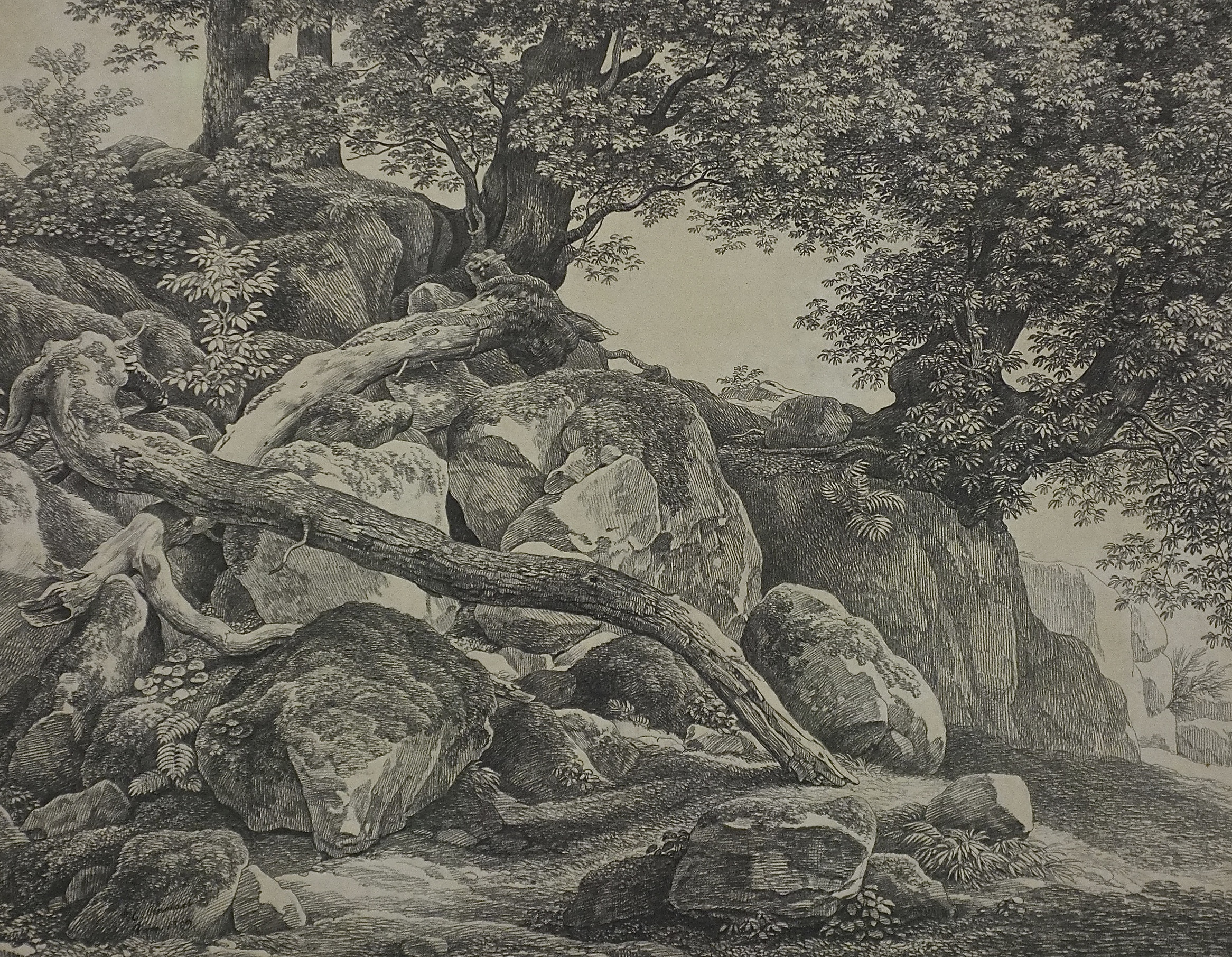
How do you begin a conversation with a stranger in a museum? At the Neue Pinakothek in Munich, in a gallery of sketches and etchings by Johann Christian Reinhart, I had photographed a detailed pencil sketch of a clump of trees and rocks when a woman came up.

“Will you take these photos back to India?”

We had seen each other a minute ago, smiling briefly as we crossed, she on her regular round, I on my way to Reinhart’s years in Italy.

“No,” I said. “I live in Germany.”

“Ah, you live in Germany. Where do you come from?”

“India.”

“India yes. But where in India?”

A short woman in a blue suit, she had Maggie Smith’s eyes and Charlotte Rampling’s lips. About sixty, very attractive. Perhaps it was the way she held herself, a manner that suggested she wasn’t a museum guard but an actor in that role.

“Bangalore.”

She hadn’t heard of the city. “Is it near Delhi? Calcutta?”

“It’s in the south.”

“A girlfriend of mine goes to India each year and spends few months there, traveling. She has seen cities in the north — Delhi, Agra, Calcutta. She is in India now, and she’s back tomorrow!” Her eyes glowed.

“Have you visited India?”

“No, I haven’t.” She pointed to her knees, shaking her head. “My feet cannot bear a long flight.” Then, after a moment’s hesitation: “But I would love to. It is a very interesting place, and Indians are very nice people.” She smiled.

“Yes, a very interesting place. Your English is good.” Few elderly Germans speak good English, and I was curious.

“Ah, I was in London many years ago, to learn English, among other things. I met many Indians there, and Pakistanis, and Africans. It was fascinating.”

I chuckled hearing her place Africans with Indians and Pakistanis. A friend of mine from Nigeria may have said to her, Africa is not a country.

I said: “London is a multicultural city.”

“Cosmopolitan, yes. Where do you live in Germany?”

“Near Heidelberg.”

“Have you been here long?”

“About twelve years now.”

“That’s a long time. Do you intend to stay or will you return?”

They always ask that. It is an innocent question to ask, a heavy question to receive.

“I’ll return.”

“Really?” She raised her eyebrows.

“Yes. Definitely.”

She smiled. “I wish you a good time here.”

“Thank you. It was nice talking to you.”

* * *

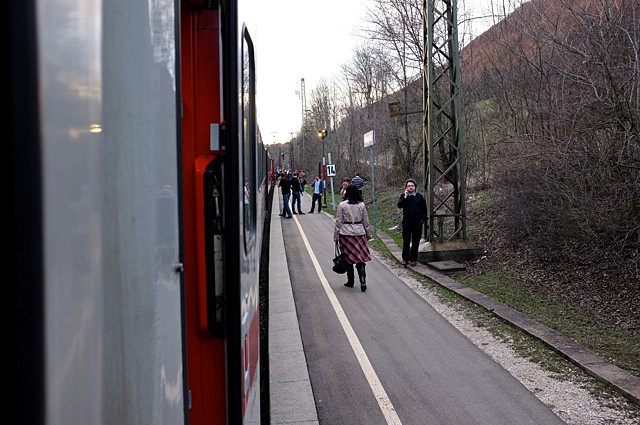
On the EC 216 back from Munich I sat next to a young woman, about twenty years old, immersed in sheets of typed paper like a girl busy with homework. Conversation seemed a possibility, but her concentration, intense and unvarying, was untouchable. Then, half an hour from Stuttgart, the train stopped. A breakdown in the line ahead, the announcement in German said, and there was no saying when services would resume. People stepped off the train. I followed, camera in hand. It was chilly outside. The sun was sinking behind rolling meadows. We were next to a small hill with a unpaved path circling it. One or two were walking up this path, others were hanging around the train, smoking, chatting, speaking on the phone, typing on the phone. I took some pictures and returned to my seat.
StoppedTrain

The woman was on the phone. A round face, rosy cheeks, blond hair parted in the middle. Her German was accented, and she had the chirpiness of a teenager. When she finished with the phone, I turned to her.

“Traveling to Stuttgart?”

“Yes. I’m visiting a friend for the weekend.”

“You’ll be late now.”

“I know!” she smiled. “I asked my friend not to come to the station.”

“Is that Polish you are reading?”

“Yes. Actually I’m translating Polish into German. I work as a translator.”

“What a coincidence! The book I’m reading is about translation.” I showed her the cover of Is That a Fish in Your Ear, by David Bellos.

She looked at the book. Then she nodded.

“I picked it up at Munich, and so far it’s very good. Right now I’m reading a chapter on why the English word ‘translation’ is inadequate, or perhaps even inappropriate, for the meaning it tries to convey.”

My mind was on the thrilling paragraph I had read on the richness of Japanese language:


If the translation we are discussing is complete, we might call it a 全訳 zen’yaku or a 完訳 kan’yaku. A first translation is a 初訳 shoyaku. A retranslation is a 改訳 kaiyaku, and the new translation is a 新訳 shin’yaku that replaces the old translation, or 旧訳 kyū yaku. A translation of a translation is a 重訳 jū yaku. A standard translation that seems unlikely to be replaced is a 定訳 teiyaku; equally unlikely to be replaced is a 名訳 meiyaku, or ‘celebrated translation’. When a celebrated translator speaks of her own work, she may disparage it as 拙訳 setsuyaku, ‘clumsy translation’, i.e. ‘my own translation’, which is not to be confused with a genuinely bad translation, disparaged as a 駄訳 dayaku or an 悪訳 akuyaku. A co-translation is a 共訳 kyō yaku or 合訳 gō yaku; a draft translation, or 下訳 shitayaku, may be polished through a process of ‘supervising translation’, or 監訳 kan’yaku, without it becoming a kyō yaku or gō yaku. Translations are given different names depending on the approach they take to the original: they can be 直訳 chokuyaku (literally ‘direct translation’), 逐語訳 chikugoyaku (‘word for word translation’), 意訳 iyaku (‘sense translation’), 対訳 taiyaku (‘translation presented with the original text on facing pages’), or in the case of translations of works by Sidney Sheldon, Danielle Steel, John Grisham and other popular American writers, 超訳 chōyaku (‘translations that are even better than the originals’, an invention and registered trademark of the Academy Press).


I would have liked to read it aloud to her, to hear the sounds of those Japanese words, but she did not show interest in the book. For someone who worked with language, I found this surprising. Perhaps more disappointing than surprising.

“What kind of translation do you do?”

“Oh, boring technical manuals, contracts, and things like that. If the original is well written, the translation is easier. Otherwise it can be hard.” She frowned, looking down at her papers.

An announcement came on air. The train was to start soon, and arrive in Stuttgart half an hour behind schedule.

“I need to check when my next connection leaves.” She pulled out the smartphone from her handbag.

There is an app for every situation.

“Do you have to wait long?”

“I can take the eight fifty-two, so that’s fine” she said.

Night was setting in. The train began to glide, and soon the windows reflected a brightly lit compartment. She had returned to her papers. I opened my book.

Kierkegaard’s lesson

This morning the radio brought in news of Søren Kierkegaard’s two-hundredth birth anniversary. The program that followed charted the Danish philosopher’s life and explored his legacy. Listening to it during the morning routine at home, I found my mind wandering to those college days when I first read about Kierkegaard in Sophie’s World, a novel by Jostein Gaarder. The novel contains a series of letters a philosopher named Alberto Knox writes to Sophie Amundsen, a teenager living in Norway. The letters speak engagingly of the history of philosophy, and they take Sophie (and the reader) on a journey with great philosophers from Socrates to Sartre. What I remember vividly are not the ideas of those great philosophers but a small incident involving Sophie’s best friend Joanna, where Joanna and her boyfriend Jeremy kiss in the garden and the adults nearby simply laugh. I was in my early twenties when I read the novel, and my first kiss was still a year away. The envy I felt towards Sophie and her friends, living in a country where kissing was commonplace, was heightened by an awareness of my own circumstance, living in a conservative South Indian town in the mid-Nineties, where even holding a girl’s hand needed enormous courage and gumption.

Our instinct for evolution, I told myself then, is far more powerful than our desire to know ourselves and our search for meaning. Things haven’t changed much since: I’d rather kiss a girl today than learn from a book the meaning of life.

The weight of inequality

[ Three months after the India trip, my mind is still on what happened there. ]

The morning after I landed in Bangalore, I went for a haircut. Raja Haircutting Saloon is near a junction in Koramangala, where the quiet lane from my apartment meets a busy thoroughfare, surrounded by a cluster of small stores selling vegetables, hardware, newspapers and magazines, Internet services, stationery, South Indian breakfasts and meals. The saloon had three empty chairs facing a wall-to-wall mirror. An unfamiliar Bollywood song was playing on the radio. On the wall opposite the mirror hung a full-size poster of Priyanka Chopra in a blue chiffon sari, hands on her hips. A dark-skinned and well-built young man in a bright yellow T-shirt appeared from behind a curtain and showed me a chair. His oily hair was combed back, he smelled of Brylcreem, and standing beside Priyanka Chopra he looked like a Hindi movie baddie. I placed my camera on the counter and sat on the reclining swivel chair. The barber spoke in Hindi.

Continue reading –>