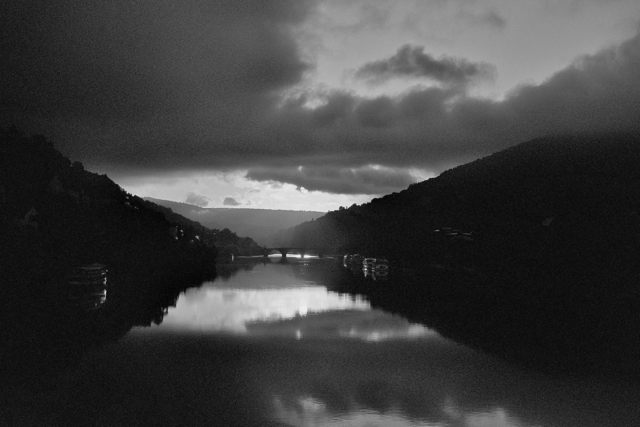
Sunrise over the Neckar, Heidelberg
Category: Observing

The library in Heidelberg is closed for summer break until the end of August. This picture will keep me company until then.
Just let it be, my friend

Sometime in the late Eighties, during my school days in Secunderabad, I watched a movie on television that left a strange impression on my mind. I must have been thirteen or fourteen, a typical Indian teenager fond of cricket, comics and movies. (Girls were only a curiosity, but that would change soon.) Every Sunday I would check the Deccan Chronicle for the scheduled evening movie on Doordarshan, and if it looked interesting I would be home in time for the 5:45 pm “Hindi Feature Film”. There was a Black & White TV at home, an Uptron portable fourteen inch with a V-shaped antenna that stuck out like a pair of bunny ears, and Doordarshan, you’ll remember, was the only channel we received those days.
On this Sunday the movie, Jaane Bhi Do Yaaro, was not one I’d heard of before, and there were no big stars listed either. But the name intrigued me for some reason, so that evening I skipped a game of cricket and settled myself on the sofa at a quarter to six. The next two and half hours had me in splits. I don’t remember laughing so much to a movie before, and since then only Johnny Stecchino, starring the incomparable Roberto Benigni, comes anywhere close. But there was one problem with Jaane Bhi Do Yaaro: I did not understand the ending, which left me sour and confused all evening, and I decided I didn’t like the movie. Next day, at school, I asked my classmates, but no one had cracked the puzzle. Why did the Vinod and Sudhir, dressed as prisoners, make that throat-slitting gesture? Were they to be hanged? Or were they already ghosts, spirits of two innocent men who were hanged, wandering in Bombay like zombies? Why, after all that fun, did the ending need to be so tragic? It simply wasn’t fair!
Points of view

1. The Objectivist
HOMELESS AND HUNGRY. HAVEN’T EATEN IN TWO DAYS. NEED TO BUY TICKET TO WASHINGTON. PLEASE HELP WITH MONEY.
New York

1. Hasidic
At the Met

At the Metropolitan Museum of Art, New York, yesterday, with Y.O.
Jewels of the East, hidden in the West

Last week, Wife and I decided on a whim to visit the Turkish quarter in Mannheim.
I had returned a few days previously from a long trip to India, and the first few days in Germany had seemed too quiet, a big contrast to the chaotic fabric of life in India. Imagine spending each day for a few weeks in a busy market, full of color and life, and returning to a monastery, where monks wore white and silence was the only sound. Even Wife thought things were unusually quiet: perhaps it was due to a short work-week (Thursday was a public holiday) that the Germans were all elsewhere, on a vacation.
Whatever the reason, we decided that the remedy was to get a taste of the East. But where? I suggested the Turkish quarter in Mannheim, a district we had discovered quite by accident while searching for an apartment last year. Wife concurred, and we set off one evening after an early dinner.
Continue reading “Jewels of the East, hidden in the West”
The road to Oslo
[Part three of a series. Earlier parts: one, two.]
In March this year, on an evening spent browsing through albums of recent trips abroad, we decided to travel north. A road trip through Scandinavia had been a recurring plan for some years now, and this Easter seemed just right to turn intention into reality.
We planned little. Two anchor points – Oslo and Bergen – were fixed and the rest we left open, to be decided when we got there. Guides on the Internet – unreliable, like so much else there – suggested not to miss the unmissable train ride between Oslo and Bergen, so I booked that too. It was, as it turned out, too much planning.
Continue reading “The road to Oslo”
If only I could write about Oslo
Since a week and a half I’ve been wrestling with the Oslo piece. The word processor tells me I have three thousand words; I think most of it is rubbish. An image from a nameless movie takes shape: a man is slumped over his desk, in front of a typewriter; crumpled pages are littered on the floor. That image carries a certain weight: physical traces of work done, of time spent. I do not have even that.
My first problem is with photographs of our trip. I cannot get them out of my head. The photographs bend the narrative around themselves, like gravity bends light, and soon they take over the narrative, making me write this or that episode about an image. I’ve had enough. I want to float free of gravity. Forget the photographs – there aren’t any in this piece. If you’re looking for an easy impression of Oslo, go elsewhere: Google some pictures, or visit Flickr.
My second difficulty is with tone. I do not know who is telling the story. Is it a tourist? A wanderer? A traveler? A historian? An academic? An observer? An enquirer? A poet? An adventurer? The choice – or choices – here will determine the tone, and influence the voice. Don’t be dismissive, this isn’t a small matter: your impression of Oslo depends on this choice. The tourist, you see, is superficial. The wanderer digs deeper, but is selective. The traveller is more holistic, comprehensive. The historian delves into the past. The academic spells out theories. The observer gives you details without judgement. The enquirer probes, analyses, passes judgement. The poet, purely instinctive, relies on images. The adventurer does, then speaks.
Continue reading “If only I could write about Oslo”
A subway ride in Brussels
0. Der Plan
HOTEL ROOM –> LOUISE –> ARTS-LOI –> COMTE DE FLANDRE –> APARTMENT

 Parmanu