
Tag: Germany
Neighbourly matters
Yesterday at the hair-dressers I ran into Frau Brecht, an elderly neighbour at my previous apartment. I hadn’t seen her since I moved out two years ago. Now she stood a few paces away, hanging her coat on the stand nearby, but showed no signs of recognition. It was unlikely she hadn’t seen me, and I wondered if this was a practical response to avoid being ignored. We often pass the elderly by without noticing them – was this instinct not to seek attention their defense mechanism?
When I greeted her, she smiled and came forward to sit next to me. I asked how she was doing. Quite okay, she replied, given that I am not getting any younger. Her eyes looked smaller, but there were no other signs of change: the same small frame, drooping shoulders, stubby feet. What about Herr Brecht, how is he? I asked. He’s getting by, she replied. He has problems with his hips, probably due to his long years as a metal worker, but he’s already eighty so that is not surprising.
Spring woods

Yesterday I collected the prints of two recent film rolls, which contained, among other events, photographs of the woods I had visited earlier this month.
Meeting Place

Sifting through some old photographs in my digital archive, I came across a collection of images from a visit last year to Wuppertal, a city at the edge of the Rühr, about three hours from here. The photographs unlocked strange memories of a forgotten visit.
The Russian Hedgehog
The Putzfrau comes home each week, to vacuum the floors, hardwood downstairs and carpet upstairs, to polish the hardwood floor panels, to clean the shower, toilet, and occasionally the windows. She is a Russian woman, in her late forties, with a quiet manner and a child-like smile. In her loose-fitting clothes she looks like a colourful bean bag, and although she moves slowly through the apartment, shifting from one room to next, her movements do not appear lethargic but suggest a steady force at work. At the end of three hours the apartment is transformed: no trace is left of the previous week’s disorder.
She has a key to the apartment. On Thursday afternoons, at around 1 p.m., when both Wife and I are away at work, she enters the apartment and leaves three hours later, carrying with her the money we place at the agreed spot on the kitchen counter, next to the Nespresso machine. On the days we forget to place the money, we return in the evening to find on that spot a sticky-note, or a paper napkin, with a message in clear letters: Geld!! On such days the apartment is as clean as on other Thursdays.
Thursday mornings are a stressful affair. Wife insists on getting the house clean before the cleaning lady arrives — to her there is no contradiction in this, it is just an “employee satisfaction measure” — so we load the dishwasher, gather clothes lying around, throw the garbage out, all this to make our home look “presentable”. The result, then, on Thursday evenings is a cumulative effect, due in part to the lady and in part to our exertions. Sometimes we are unsure who has assumed the larger burden.
Year-end musings
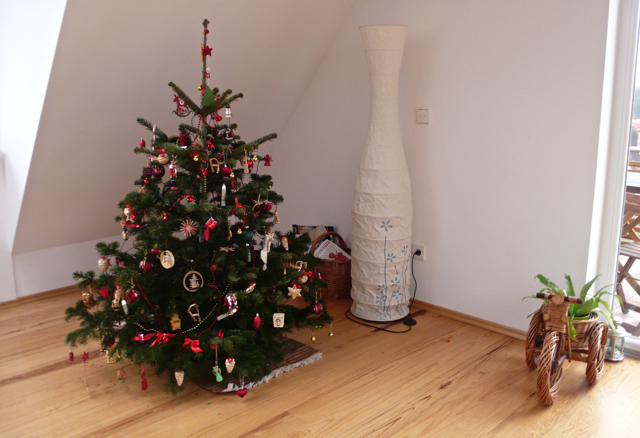
In the last ten years or so the Christmas and New Year week has, for us, acquired a particular significance, shaped by a culture-driven consciousness that this is a period of renewal, a time to take stock of the year gone past and to prepare for the new one ahead. Renewal, old giving way to new, is conveyed through a total shut down of commerce (workplaces are empty; business slows to almost a halt; stores are closed from the afternoon of 24th until the 27th morning, and if you do not stock up earlier only the kindness of neighbours or friends can save you), and all the year-end lists in magazines and newspapers send home, unequivocally, the message that this is a changeover period. In all, a sense of ending, an intimation of a beginning.
Being and foreignness
“For the first time in history, across much of the world, to be foreign is a perfectly normal condition.” — The Economist, December 17th 2009
1.
The Weihnachtsmarkt in this town was a small affair. It began at the western end of Hauptstrasse, with a stall selling dry fruits and nuts, and continued up the street, extending partly into the neighbouring Marktstrasse or Blumenstrasse, and ended at the eastern perimeter less than a kilometer from the start. The stalls, small log cabins with pine sprigs and yellowish light bulbs strung across their roof angles, displayed the usual wares: chocolates and gummy bears, gluh wine, crepes, potato pancakes, bratwurst & schnitzel, christmas-tree knickknacks, and ceramic crockery. At the intersection of Marktstrasse and Höllgasse there was a small carousel, manually operated, with eight horse-shaped mounts each painted a different colour. Not far from it stood a märchenzelt, a fairy-tale tent, white and round with a conical top, glowing like a dimly lit bulb. This tent was where I was headed, with Wife and some friends, on a cold and overcast November evening not long ago.
The evening’s plan was simple but unusual: from 7 to 8 P.M. children visiting the tent would be read Indian stories in German by a few Indian ladies. Wife, one of the storytellers, had made me a target of her daily practice sessions the previous week. The story she had chosen (“Sukeshini and the lake demon”) was about an Indian girl who tricks a demon and brings water to a drought-stricken village; she had translated it into German with the help of a friend. Others had chosen similar stories, Indian folk tales translated into German.
Inside the märchenzelt six or seven boys and girls sat facing a middle-aged woman reading a German fairy tale. At 7 P.M. the Indian ladies, dressed in colourful sarees or salwar kameez, started the session with a Namaste. “This is how you greet people in India,” one of them explained. The children mimicked the gesture and giggled. Then the stories were read out loud, one after another, each storyteller pausing in places to ask a question or to explain the context. Some of this context was presented as illustrations: colour printouts of scenes from the story — taken from the original storybook — or of an Indian situation or custom, like a festival or a feast served on banana leaves. The kids looked at the copied illustration before passing it on, and occasionally a curious parent leaned over their tiny shoulders for a quick glance. In the middle of the hour, after a couple of stories, the ladies sang a nursery rhyme in Hindi. The boys and girls were asked to repeat, line after line:
Haathi Raja bahut bade
Sund utha kar kahan chale
Mere ghar mein aaon na
Halwa puri khaon na
Aaon baitho kursi par
Kursi boli chatar-pattar!
The parents joined the children in this recitation. It was a charming reversal, with the Germans attempting what the Indians had been doing so far: speak in a foreign tongue.

At the hour’s end the children sang the rhyme once more, said Namaste, and left. Outside a slight drizzle had begun; we picked up some gluh-wine and crepes and stood chatting under the awning of an electronic store, next to its brightly lit windows. The store appeared closed, but soon a man approached us, with the obvious intention of entering it. Middle-aged, huge and bald and white like a WWF wrestler, he stopped in front of me and asked, with a half-smile: “Darf ich?” May I?
The politics of foreignness
[Part 3 of the Interpretations series.]
“This is not a good time to be foreign.” — The Economist, November 19th 2011
 Earlier this month, xenophobia again grabbed the headlines in Germany. Investigations following the arrest of a woman, one of three members of the “National Socialist Underground” group, revealed that they had killed nine people between 2000 and 2006, and injured many more with a bomb in 2004; eight of the nine killed and most of those injured were of Turkish origin. Until this recent discovery, none of these hate crimes against foreigners were linked to the neo-Nazi group. (Suspicions were directed instead at the Turkish mafia.) The news caused the Germans embarrassment, shame, and regret, in that order. Media uproar followed, and the issue reached the parliament. Chancellor Angela Merkel called it a “Disgrace”. Politicians renewed their call for a ban on the far-right National Democratic Party (NPD). On the 22nd, two weeks after the sensational discovery, the parliament issued a joint statement that began: ”We are deeply ashamed…”
The eye is a lonely hunter
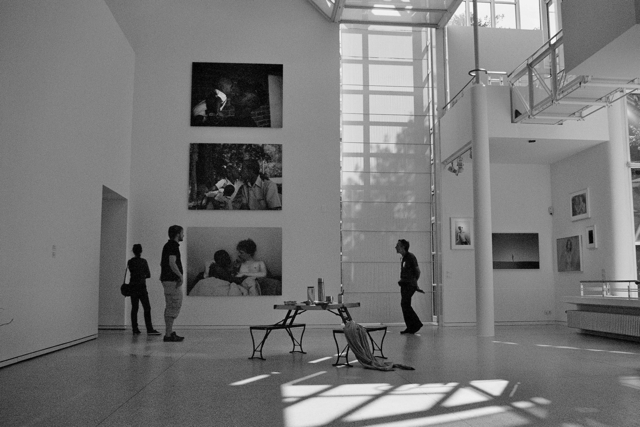
An exhibition at the Heidelberger Kunstverein.
An Indian in Germany
[Part 2 of the Interpretations series, which began here.]
In the winter of 2000, a few weeks before we left India for Germany, Wife and I were invited by a relative for a farewell lunch. This uncle and aunt were encouraging and optimistic about our plans to migrate (“At least you aren’t going to the U.S. like the rest of them,” they said), but the aunt’s father, an elderly man with hawk eyes, took a different view. “Why are you going to Germany?” he asked. “It is the most racist country in the world, don’t you know? Haven’t you read about Hitler and the Jews? The Germans hate foreigners — I would think ten times before going there.”
 Parmanu