When did you last go to the library?

During an idle afternoon on a recent trip to Trivandrum, I visited the State Central Library. Inside the stately Gothic building, a uniformed official was looking into a register on his desk. I approached him and asked where I could find the English collection.

He did not understand English. Malayalam was a tongue I understood but struggled to speak. I tried Tamil – not my mother tongue, Kannada, but closer to his language – and it worked. To gain access as a visitor I had to fill out a form and get it signed by the “duty librarian”. The form was in Malayalam, and he pointed to the spots where I had to fill in my name, address, and purpose of visit. “Visiting,” I wrote.

The duty librarian was a young woman seated behind a desk in a wooden cubicle. There was no one else around, so I walked up to her and handed the form. At the bottom of the page she wrote “Permitted to visit library,” signed below, and added the date. I asked her about the sections in the library. After giving me a broad outline of the building, she directed me to where I could find books in English.
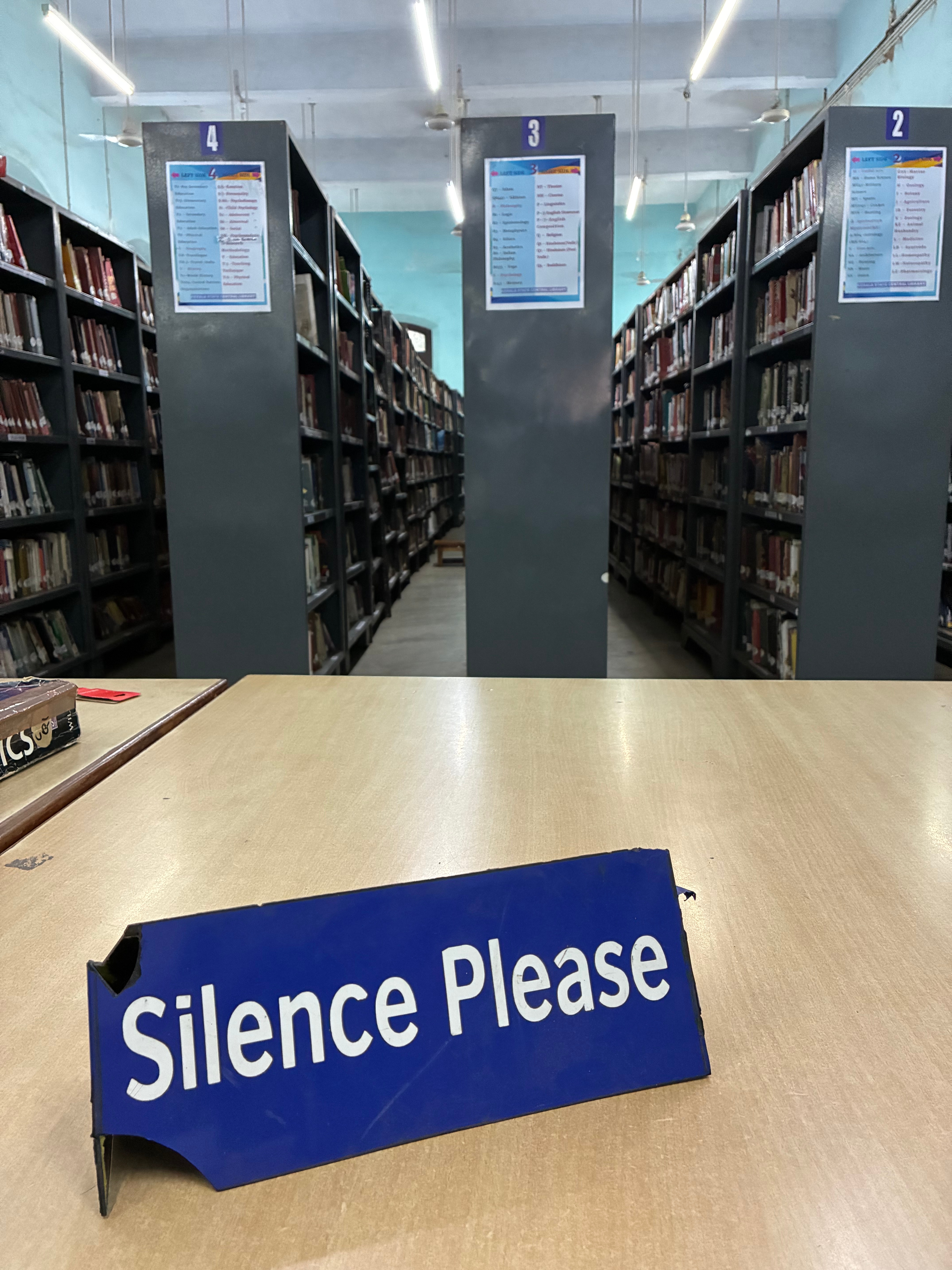
I spent two hours in the tube lighted hall stacked with books in English, sitting at a large wooden desk under a ceiling fan, reading through snippets of books I picked from shelves with labels that interest me these days. One of the labels read, “The social problems of and services to groups of people”.

The library was empty and silent. Occasionally one or two young women would pass by. Another librarian, a middle-aged woman in a salwar kameez, sat nearby cataloging a stack of books. After a while she left and another woman took her place.

When I left the building, I felt a mixture of elation, loss and disquiet. Such spaces are a gift, but we can no longer take them for granted. I thought about the library in Heidelberg that was a 5 minute walk from our home in that city; I thought about banned books no longer available in libraries in the US; and I thought of a photo essay I’d read recently, with text by Jerry Pinto that ended with these words:

“That edifice which looks so imposing, those rows of books which look so welcoming, they are as susceptible to the passage of time as you are. Time ravages books just as much as silverfish, mildew and blades wielded in secret and in silence.

The book has many enemies. So have libraries. But the worst enemy of all is the sound of receding footsteps, as people walk away from libraries.

Tell me, when did you last go to the library?”

Rediscovering India


AtWork


Words are the only jewels I possess
Words are the only clothes I wear
Words are the only food that sustains my life
Words are the only wealth I distribute among people

— Sant Tukaram


The South Asia Institute, which belongs to the Heidelberg University, offers courses in Transcultural Studies, Indology, and other themes related to the Indian subcontinent. I had heard of those courses on a few occasions, but the subjects did not interest me, and I knew no one studying or working there. So for a long time the South Asia Institute remained a name related to my country of origin, no more.

My curiosity grew when I saw, not long ago, a pamphlet that advertised a library, an English library at the South Asia Institute. It was open to the public, Monday to Friday, 10 am to 7 pm. I decided to make a visit.

* * *

No. 330, a six-storied building where the South Asia Institute is located, stands next to a group of similar buildings that belong to the local hospital. They share the same parking lot. You see a few gloomy-faced people walking about, but it’s hard to say if they are university faculty or relatives of a terminal patient. A few bicycles are parked outside 330, locked to the aluminium railing, and a small revolving door, bright red and hard to budge, ushers you into the foyer. The concrete walls inside carry a thin coat of white paint, the gravelled floor looks untidy: the hall bears the unfinished look of a parking garage. At the center a narrow stairway leads upstairs. A man with South Indian features is standing to the left, his hand holding the elevator door open, his eyes on me.

“Are you on your way up?” he asks.

“I’m looking for the library, actually.”

“Take the stairs – one floor up.”

Upstairs the reception area is large and airy. A glass partition splits the hall, and behind the glass are two rows of unoccupied computer terminals. On another glass partition, which encloses two sides of the reception desk, hangs an array of amateurish but well-composed photographs from the subcontinent: a buddhist temple, a riverside ghat in Benaras, a street in Nepal, an Indian bazaar, and so on. Returned books are stacked on a trolley, waiting to be replaced; new arrivals are displayed in glass cabinets, like gems in a jewellery store. Rabindranath Tagore, head inclined toward the half-written page, stands alone in a corner, composed, carved in black. Next to him is a notice board announcing events and courses, and on the opposite wall a series of bronze-coloured frames enclose portraits of Hindu mythological figures. I could be inside a university building in India.

The only person I see around is a young lady at the reception desk, absorbed in a collection of catalog cards like a monk with a manuscript. It is half past ten on a Monday morning.

Continue reading “Rediscovering India”