There are some days – and this happens much too infrequently – when he feels he is living in a dream. But in this dream he is in a state of heightened awareness that makes him piercingly sensitive to everything around him. This Saturday is one such day. Continue reading “Saturday”
Category: Simply Living
Winter’s gift
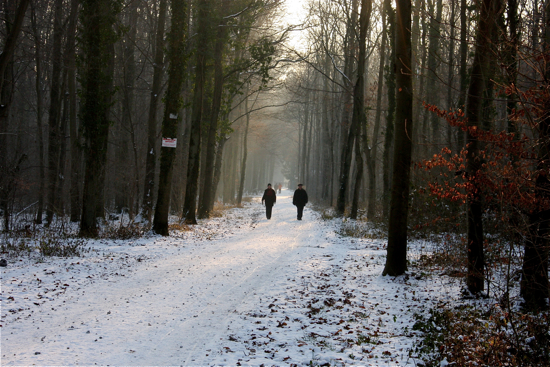
Last Sunday, when I decided to go for a walk in the nearby woods, I had no idea what lay in store for me. It had been a while – a couple of months, perhaps – since I’d walked there. That afternoon, cold but sunny, I felt an urge to explore the woods in winter. Continue reading “Winter’s gift”
2008 in lists
A summary of the year in lists of notable experiences/events/things:
Books – Fiction
– The Reader (Berhnard Schlink)
– The Book of Other People (edited by Zadie Smith)
– Sea of Poppies (Amitav Ghosh)
– The Enchantress of Florence (Salman Rushdie)
– The White Tiger (Arvinda Adiga)
– Thank you, Jeeves (P.G.Wodehouse)
– The Elegance of the Hedgehog (Muriel Barbery)
– Buddha – part 1 (Osamu Tezuka)
Books – Non-fiction
– The shadow of the sun (Richard Kapuscinski)
– The Halo effect (Phil Rosenzweig)
– Fixing Climate (Wallace Broecker and Robert Kunzig)
– Cultural Amnesia (Clive James)
– A Little History of the World (E.H.Gombrich)
– Antiquity (Norman Cantor)
– Essays in Love (Alain De Botton)
– Edward Hopper (Lloyd Goodrich) Continue reading “2008 in lists”
Medium matters
A few weeks ago the owner of the apartment I am staying in visited my home with his wife, on a matter related to the apartment. The Quasts are retired; they live in a quiet neighbourhood a few streets away. Their English, like many of their generation, is rudimentary, and in the early years of our stay conversation was limited to a few sentences on house-related matters and some pleasantries about the weather. Now-a-days I am able to sustain a simple conversation in German, so the range of topics has expanded.
On this occasion, the subject of vacations came up, and they asked if we had travelled anywhere recently. I told them about our Spanish holiday, and, on an impulse, reached out for my MacBook with the intention of showing them some pictures of the trip. They were seated on the sofa; I handed them the laptop – which they held onto in a gingerly fashion, balancing it on their laps so that they could both look at the screen together – and started the slideshow. Standing next to them, I explained the background behind a few shots. Spain is a beautiful country, they said, and added that the pictures brought this out nicely.
A week later I visited them to get a signature on a form I had to send to my parents for their German visa application. Herr Quast welcomed me in his usual warm manner, led me inside and seated me at their dining table. His wife joined us, and after enquiring what I’d like to drink – an offer I gently declined, stating I had to leave soon – she sat down and began to chat. Soon the topic of my parent’s planned visit this summer came up. I mentioned that they wanted to see more of Germany this time as the itinerary on their previous visit was filled with visits to other European countries – France, Switzerland, Belgium, Holland. Frau Quast’s eyes lit up when I said this, and she came up with a flurry of questions: which places in Germany do they want to visit? Did they like cities, or the countryside? Had they seen Hamburg? Dresden? The Mosselle valley? We could offer some suggestions, she said, and left the room.
She came back with a thick file and placed it on the table. Inside, I could already guess, was a treasure of memories: the pages recorded many trips they had made in Germany over the recent years. She turned to a cycling expedition with another couple some years ago, along the banks of the River Elbe, from Dresden to Hamburg. The section began with a map of the route, which was followed by pictures that were clipped to the sheets with a paragraph or two of cursive script describing the moment. Then there were bills from restaurants they had eaten at, receipts from shops they had visited, tickets of concerts or movies, brochures of the region and other little scraps of memory that brought back minute details of the whole trip. In between explanations of this or that picture, Frau Quast would turn to her husband and recollect a day on the trip, or some event that came back to memory.
I had intended to stay not longer than five minutes, and wanted nothing more than a signature on a form; when I left, I had spent more than an hour, and was carrying with me itinerary suggestions that could fill six months of travel around the country. On my walk home I reflected over the two mediums, paper and digital. When it came to sharing something with people around us in the real world, the immediacy and personal touch conveyed by paper was superior to the impersonal, disconnected nature of the digital medium. My choice of the latter medium in the last years also indicated how my relationships had increasingly moved online – I shared more with people elsewhere than in my own neighbourhood, and for such global interactions the digital medium had to be preferred for the convenience it offered. But I was less sure that sharing through digital media – no matter how sophisticated the technology or how beautiful the website – could ever acquire the quality of sitting with a person on a table with a physical album full of pictures, maps, tickets, and recounting stories that made the trip memorable.
The year so far
Four months have gone by in 2008, and it seems like it was just the other day we returned from our holiday in Spain, at the beginning of the new year. Gathering pieces of memory that would create a narrative for these months seems impossible without sifting through my collection of photographs.
January

January, a cold month which brought no snow this year, passed by quickly. On occasional visits to Heidelberg (to return a book or DVD at the library) I would brave the cold and walk to the bridge for a glimpse of the river and castle.
February

In February I got my old Canon (EOS 300D) repaired. There was a problem with the lens contact points, which the Canon factory fixed at no cost (to my pleasant surprise) and it was good to have the camera back in a mode where it worked consistently. I experimented with shooting under low-light conditions with the 50 mm F1.8 lens; the results were mixed.
During a weekend at Brussels, Wife and I drove to Antwerp to watch Jodha Akbar. Antwerp is known for its diamond industry, and the place is full of gujjus; at the movie hall almost every person seemed to know everyone else. About the movie, less said the better; Wife and I laughed a lot at the movie’s expense, while the Gujjus sat watching with the reverence a historical movie demands. (As to how we felt about the movie, you won’t find a better description than this one.)
March
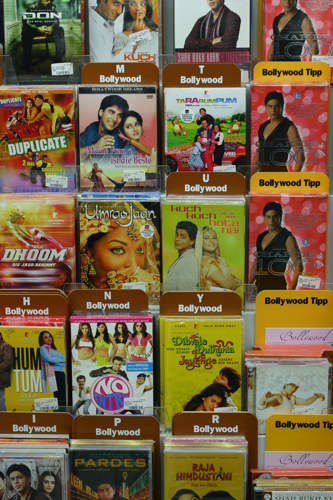
In March, on a trip to Cologne, Wife and I ran to an exclusive section for Bollywood movies in one of the shops. Shah Rukh Khan is a big star in Germany, and the craze for Bollywood movies is such that you can just as easily encounter a movie flipping through the TV channels here as you might in India. All movies, of course, are dubbed into German (which makes them hilarious to watch, especially the parts with some local gaalis).
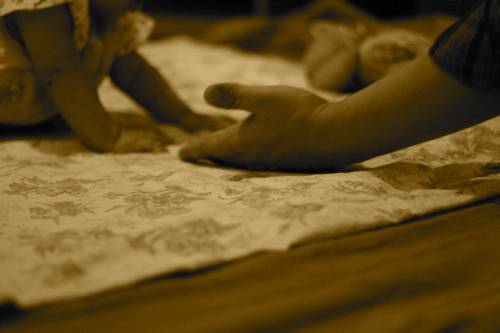
March was also the month where we got to see little P again, back from her long trip to India. At six months, she has the enviable ability to draw you into her world with her sharp eyes, penetrating glances and delightful mannerisms.

Then there were the regular trips to Brussels. The city has a different poster culture, in contrast to what I see in Heidelberg (where one mostly finds announcements for operas, concerts or theatre). Film posters abound in Brussels, and at times they give an otherwise dull neighbourhood a dash of colour and character.
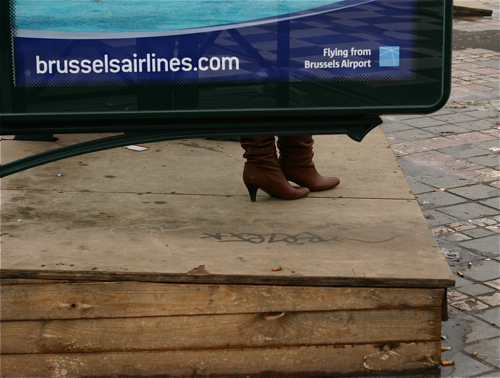
When it comes to fashion, Brussels is a poor cousin of Paris. But it does try hard to keep up (I can see that from my Wife’s shopping receipts), and occasionally one gets an image that combines the elegance of Paris with the squalor of Brussels.
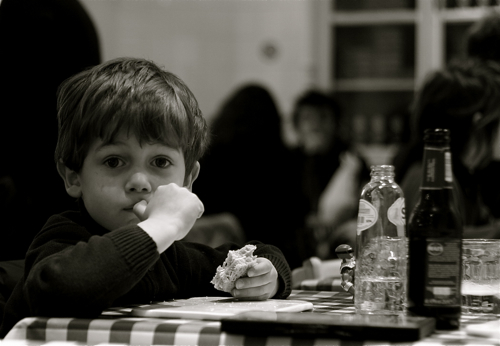
Saturday mornings we sometimes go out for breakfast at one of city’s many bustling cafes. On one occasion there was this little boy sitting with his papa, silently munching a sandwich. I couldn’t resist pointing my camera at him, and like any good subject he obliged with an unforgettable expression.
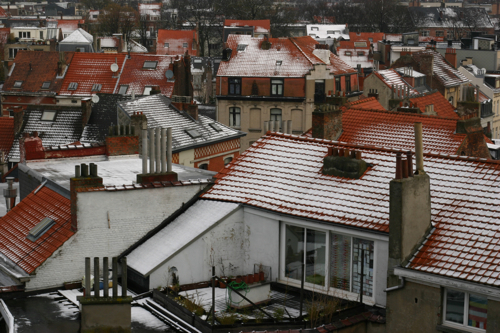
It snowed during Easter (The radio weather reports were full of excitement about a “White Easter”). And although the snow hardly lasted, it gave a glimpse of how snow can transform a landscape. I was looking forward to an image of Brussels rooftops full of snow, but that will have to wait another year.
April

At the end of March I bought a new camera – the Canon EOS 40D. The old one still works (although it occasionally has problems with the light meter, resulting in pictures that are horribly overexposed), and I’ve decided to donate it to Wife (minus the best lenses, of course, which I will add to my collection). I’m still getting used to the new body (and another new lens – the EF 24-105 L IS USM) and the weight. So far I’ve been very satisfied with close-ups but the landscape pictures leave much room for improvement.
The Reader (by Bernhard Schlink) had been lying on my bedside for a while, and I finally picked it up in April. It was a day of strange coincidences. In the morning I picked up a slightly old copy of The New Yorker and read an article about a photo album describing life of German officers at Auschwitz; among other things it alluded to the ladies who worked there as secretaries, and described how they seemed to live as though it was just another job. It made me think about the possibility of exploring the life of one such woman after the war – what she did after the war, and how her life during the war affected the one after it. It would make an interesting subject for a novel, I thought. Later in the day I picked up The Reader, and it turned out to be an exploration of a very similar (if not exactly the same) theme. After finishing the book (engrossing and thought provoking, to say the least) by evening, I learned that the German movie “Die Welle” was playing in a nearby movie hall. I had recently heard about the movie in which a teacher, when challenged by his students that what happened with Nazi Germany in the 30s was no longer possible in today’s society, makes them part of a social experiment that in the end goes horribly wrong. I watched the movie that night – a chilling end to a day that took me back to that era.
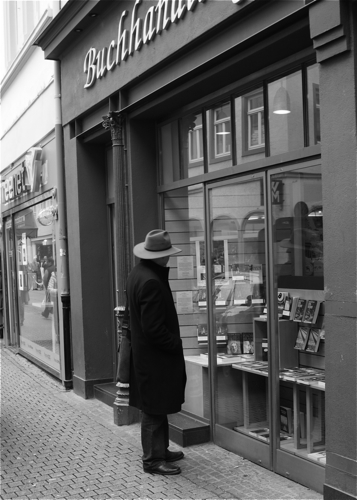
I spent weekends in April experimenting with my new camera and lens.
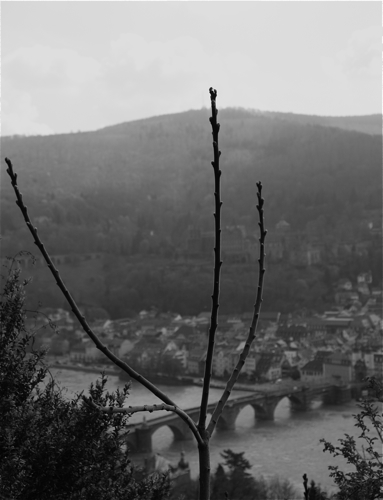
On one such weekend I went for a walk along Philosophenweg, which offered beautiful glimpses of the old part of Heidelberg, beyond the Neckar river.

There were also more trips to the woods, which meant both time and space to experiment with the surroundings. The above picture gave me confidence that the new lens is great at least for macro or portrait photographs.
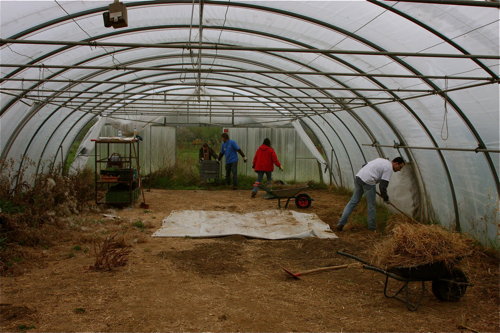
In the third week of April, I spent a day volunteering at a social organization that provides services for people with autism. It was part of an event organized by my employers; around 300 employees volunteered and were allocated to various projects based on our preferences. In the morning half our group helped weed out and clean the greenhouse; later, when it stopped raining, we worked in the field with lawnmowers. The autistic children – all teenagers – worked with us through the day, some accompanied by their mothers. It was a revelation to watch the care and empathy the mothers showed throughout, without the slightest sign of tiredness or resignation that one sometimes sees with mothers of normal children.
* * *
Photographs offer a potent means to record memories, but while they convey a lot of detail in very little space, relying only on photographs would make me miss out on many events that happened “in between”. Nevertheless, I’m going to experiment with this style for a while – so you are going to see a lot of pictures in the weeks ahead.
Hyderabad diary – The Homecoming

The day after I arrived in Hyderbad I drove with my parents to the university campus. It was a Sunday evening, and my father remarked that the traffic was moderate. “You should see it on a weekday,” he said, “The city is beginning to resemble the nightmare that Bangalore has become.” To me, the streets seemed to bustle with activity in a pleasing sort of way. Perhaps it was the effect of light: the last rays of sunlight that penetrated the maze of closely-spaced buildings conveyed a golden tint to everything in their path. I took pictures whenever we stopped at a traffic signal.
We had been invited by Professor Ujar, a friend of our family, to watch a play being staged by the university students. It was a play by Harold Pinter titled, coincidentally, ‘The Homecoming’. When I had learned of this opportunity last week while still in Germany, I had asked father to block our seats immediately.
Entering the campus was a bit like leaving behind a dusty desert for an oasis, green and quiet. Professor Ujar, who in his greying baldness and wide-rimmed glasses looks every bit the distinguished academician he is, welcomed me with a warm hug and introduced us to other friends he had invited. We soon found ourselves walking through the campus towards the auditorium. Along the way a few passers by stopped to greet the professor. One girl came up to him with a plea: the show was sold out and she wanted very much to watch the play – could he help?

The auditorium was small – which is always good for a play – and the props – a sofa set, some chairs and a table, a coat stand and a stack of drawers – were set not on but below the stage, right in front of the audience. (We were to learn later that the stage was in a state of disrepair, hence this shift in platform).We sat in the front row – a privilege offered to friends of faculty – but in the narrow space between us and the beginning of the actor’s area were a few rows of mattresses where students soon settled down, chatting and giggling merrily.
The play began fifteen minutes past scheduled time, and ran for two hours across two acts. Although the amateurism was evident in places, it was a spirited, enthusiastic performance. The larger problem, I thought, was with the theme, which didn’t seem to fit with the background of the actors; I’m not sure if a play like this – with characters from the working-class in London, speaking a tongue that was hardly respectable and having strangely disrespectful and inconsistent attitudes towards women – can be performed effectively by Indian-looking-and-speaking actors. It was a bold theme, and I was surprised at the ease with which these young students handled some intimate scenes. Consider this extract from the play (at this point LENNY and RUTH are in each other’s arms, kissing):
JOEY goes to them. He takes RUTH’s arm. He smiles at LENNY. He sits with RUTH on the sofa, embraces and kisses her. He looks up at LENNY.
……
He leans her back until she lies beneath him. He kisses her. He looks up at TEDDY and MAX.
…..
LENNY sits on the arm of the sofa. He carresses RUTH’s hair as JOEY embraces her. MAX comes forward, looks at the cases.
……
JOEY lies heavily on RUTH. They are almost still. LENNY carresses her hair.
…………..
JOEY and RUTH roll off the sofa on to the floor. JOEY clasps her. LENNY moves to stand above them. He looks down on them. He touches RUTH gently with his foot.
Sitting next to my parents, a part of my mind was dwelling on their reaction to all this on-stage intimacy from youngsters. In the end, father liked “the eloquence of speech” from the actors, while mother found the whole thing “strange”.
On the walk back from the auditorium Professor Ujar explained the reason for the delayed start: some students, mostly from the backward-caste category who had been admitted through the reservation quota, had insisted on watching the play even though it was sold out, while the students in the organizing comittee were wary of the trouble these students could create while the play was on. The Vice Chancellor of the university had to step in to resolve the matter, and after a caution the protesting students were let in. “The students who staged the play,” explained the Professor, “are from the more elite sections of the student population, and they are not too comfortable with the other sections.”
The local Times covered the event, and the article that appeared two days later had only nice things to say about the play (which is probably what the young students need, to motivate them further). It was a short piece, and one sentence instantly caught my eye:
“An existentialist play by Pinter would never be the easiest thing to stage. So, they decided to get it off the stage, and performed in the gallery!”
The coming weekend another group of students from the university is performing Girish Karnad’s Hayavadana. That sounds more promising, somehow.
Week and Weekend
The days are warm. He walks each day to work, is back by seven – which is early, going by his normal schedule – and spends most of the evening reading Sacred Games. He is taking it slowly – a book seven years in writing deserves seven weeks of reading – and is enjoying each scene, every encounter, the texture of each memory, the sting of every gaali.
He cooks his usual rice meal – vegetable pulao – which he eats with pickle and yoghurt, taking in the exploits of Gaitonde between spoons of rice and pickle, unable to decide where the feeling of spice originates from: the food or the book.
He likes this life, this solitude. He likes the empty house in a silent neighbourhood where he can spend his evenings reading, contemplating, dreaming. When he speaks with his wife on the phone, he mentions how much he loves being alone. Then don’t come this weekend, she says, pretending to be upset. He laughs, and says weekends are for her – he needs only the week for himself. Then you do not want me back? she asks; you do not want to spend the weeks with me?. He laughs again.

Late in the night, before sleeping, he jots into his journal some events of the day. He has been doing this regularly since he acquired a Moleskine notebook recently. He likes the growing collection of pages full of memories, and he often goes back to the previous entries. What is this journal, and what is that other one online? Why does one person need two? Both are needed, he tells himself, because there are really two selves. One that wishes to be alone, and one that wants to reach out to the world and participate in it. One for the week, the other for the weekend.
Living in two places
I’ve often wondered what it is like to live in two places. This condition seems common among authors: on the back-cover of a book one finds, every now and then, a description of someone who “lives in New Delhi and London” or “divides her time between New York and Paris”. What sort of a life is it, dividing time between two societies, two cultures, two groups of people? What does one gain, and at what cost? I never thought I’d be rich enough to afford a life like that, but life is strange: it answers your wishes in ways you could hardly imagine.
Since about an year and half I have been, in a way, living in two places. On weekdays I’m in my town, south of Germany; on weekends – many, if not all – I travel to where Wife lives. Last year, when she was at business school, the destination was Lausanne; this year, since she started working again, it’s been Brussels. The arrangement isn’t one bit like the authors I mentioned before: they probably have periods of extended stays in either location, a luxury I cannot afford. My experience has been mixed, and has involved plenty of travel, diversity and accumulation.
The idea of travel is mostly associated with business (traveling to a conference) or pleasure (traveling to the beach resort). The sort of travel I do on the weekends is neither; one could call it a mix between spousal obligation and a desire for change. There is little planning involved: on Friday evening I throw some essentials into a bag and start driving. Unless there’s a jam, it’s a five hour drive; I take a couple of breaks in between, to refill the tank, to have a coffee or simply to feel the wind outside. The music is almost never what’s on radio, but something consistent, long and complicated: like an opera or a classical concert piece. The onward journey is always better – the weekend is ahead – and what always strikes me on my way back is that where you are does not matter as much as which way you are going.
The change of place every other weekend does a lot of good. I live in what is often described, not without reason, as a “sleepy town” and Wife has – on both occasions – been a city dweller, where the pace of life is different, the people are different, the language is different: refreshing changes, and always welcome. Another home – a living space – opens new possibilities: in Brussels, Wife stays in a high-rise building, and I spend hours simply looking at the Brussels skyline….

… and on occasion at neighbours picnicking on their rooftops.

A second home also serves as a base offering possibilities of further exploration, an advantage we are yet to make full use of in Brussels. From what little I’ve seen of the city so far, I think it merits the label of European Union’s capital: it seems to have a bit of everything, from elegance to squalor, a mix of old and new, people variously coloured and weather that changes before you can spell RAIN. The other day we walked into a street where a bazaar had sprung up, with all manner of old and used stuff displayed in stalls next to the footpath. A convenient way to get rid of unwanted house-hold goods, I thought.

My mind at that moment was on something I had been pondering over for a while: a second home also means two of most things, including household “essentials” needed in any modern dwelling: TV, DVD player, Washing Machine, Vacuum Cleaner, Iron Box, furniture of all sorts, Cutlery & Crockery…. the list goes on. I often wonder what we would do with them once Wife and I begin to live together again. The big items can be sold, but my concern lies behind the small things we accumulate but rarely need: my own apartment is full of such things that have somehow managed to slip into the house over the last six years, and I shudder to imagine the prospect of bringing that lot together with all of what Wife would have picked up at her apartment over the next year(s). To make matters worse, the influx has grown after we’ve setup two homes: in order to avoid carrying along things from one house to another each weekend, we’ve duplicated many things in both apartments; I now have two toothbrushes, two shaving kits, two home slippers, two sets of towels…
In a way, I’ve only just begun. There’s at least an year of this mode of living ahead of me, which means more travel, variety and accumulation. I’ll certainly have more to say on this topic after it all ends: one begins to understand the true nature of things only with time, and distance.
Books, Theater and Grapes
Last weekend, between the 7th and 8th of October, we watched a play, stole grapes from a vineyard, and walked through long corridors lined with books from all over.
The play – “3, Sakina Manzil” – was by Ramu Ramanathan, a Mumbai-based playwright. It was brought to Frankfurt as part of the events surrounding the Frankfurt Book Fair, where India was the “Guest of honor” this year. Such events are rare in Europe, and I chose to add this evening at the theater to our weekend itinerary (Blogger Alpha and her friend S were visiting us on their Europe tour, and had to put up with such indoor events in their weekend sight-seeing agenda).
 A play with two characters, “3, Sakina Manzil” is set in the 1940s, and centered around the Bombay dock explosion that took place in 1944. As I watched the spotlight move from one character to the other, as I heard them speak in that English we Indians have adopted and made our own, as I experienced the story unfold in the Bombay atmosphere with names, expressions, images that spoke of an Indianness I’ve known since childhood but miss now, I felt a wave of nostalgia flow through me, a wave that held me in a trance throughout the play. Later, S mentioned that it could have been shorter in places, but I had been unable to notice any of that. To me, it filled a large vacuum created, on the one hand, by limited opportunities for such “authentic Indian experiences”, and on the other by the increasing scope my work (an occupation that has little to do with the world of art I long to be a part of) is having on my life these days.
After the play, the author spent close to an hour answering questions. The audience was predominantly German, and it conveyed a warm appreciation for the play, significant understanding of the art and a great deal of curiosity towards the specifics of Indian culture and theater scene in India: “The woman in the play was shown as a strong character – were Indian women like that in those days?” ; “Why did you choose an unhappy ending? Wouldn’t it have been more popular among the Indian audience had it been otherwise?” ; “How many such plays are staged in Mumbai? What is the infrastructure? Is it possible to make a living out of theater?”.
Ramu Ramanathan answered all questions with a simplicity and clarity that reflected his down-to-earth nature. It was surprising to hear that although he had been writing plays for many years and staging them in India, none of his plays had been published (He spoke of an ongoing attempt since four years, with the manuscript going back and forth between him and the publishers who were asking for one change after another ). However, a Dutch translation of “3, Sakina Manzil” was on the pipeline, and it was hoped that this would spur further interest among foreign audiences (This was the first time they were staging it outside India). He spoke of the strong theater culture in Maharashtra (“There is a joke amongst us: you only need to scratch a Maharashtrian and he’d end up writing a play!”), and of a lifestyle that sometimes involved staging three plays in different theaters in the city on the same day, which meant the props had to be simple enough to be disassembled within minutes and packed into a van, a vehicle where the actors and playwrights lived while on the move.
All this served only to enhance my nostalgia; I consoled my mind telling myself that this intensity of experience would not be possible had I been able to watch Indian plays every other weekend.
* * *

Earlier that day we drove to Sasbachwalden, a small town in the Black Forest region.
We walked through mostly empty streets lined with pretty tudor cottages, crossing now and then a bubbling brook. Soon our path wounded around a small hill and ended next to a vineyard full of ripe grapes. The girls made most of the opportunity; I wouldn’t be surprised if Germany reports a small dip in wine production for the year 2006.
* * *
On Sunday afternoon we visited the Frankfurt book fair. The “India” theme was splattered all around: on posters, brochures, giant wall hangings displaying authors from the sub-continent, events with famous Indian personalities (we narrowly missed a press-conference with Mira Nair; other events, like readings from authors like Vikram Chandra, Pankaj Mishra, Vikram Seth, Shashi Tharoor, U.R. Ananthamurthy etc had been held through the week).
We had only a couple of hours before the event closed, and as I wandered through the halls the familiar feeling of cultural density enveloped me: I could not imagine another situation where one could get a glimpse of such a wide array of cultures in so small an area. It made you realize how much more there is to be seen, experienced.
Each year I come back from the fair with a list of books (only a list, as books are not typically for sale at the trade fair). This time one book caught my attention: Privacy, a collection of stunning black and white portraits of families in Delhi, by Dayanita Singh.
* * *
It was an eventful weekend, one that passed too soon. Alpha, true to the traits one sees in her writing, was full of humor. Her enthusiasm is infectious: there wasn’t a single dull moment throughout the weekend (which, with someone like me around, is quite a feat – you only need to ask my sister). She left behind plenty of laughter, and a book I’m beginning to love: Vikram Chandra’s Red Earth and Pouring Rain. Thank you, Alpha.
FIMU
At FIMU (the music festival in Belfort, France) last month.


 Parmanu