The bus ride to work


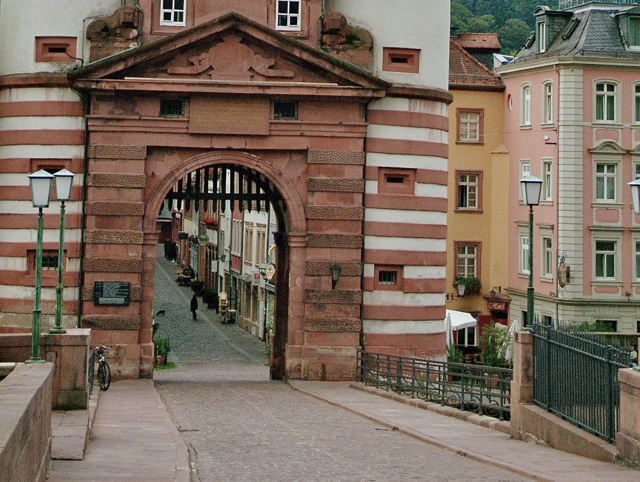
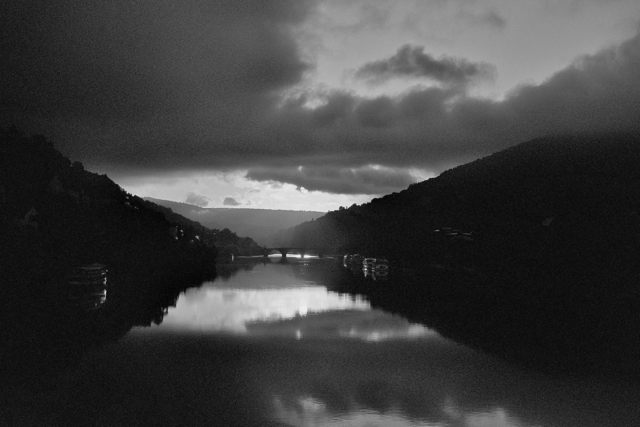
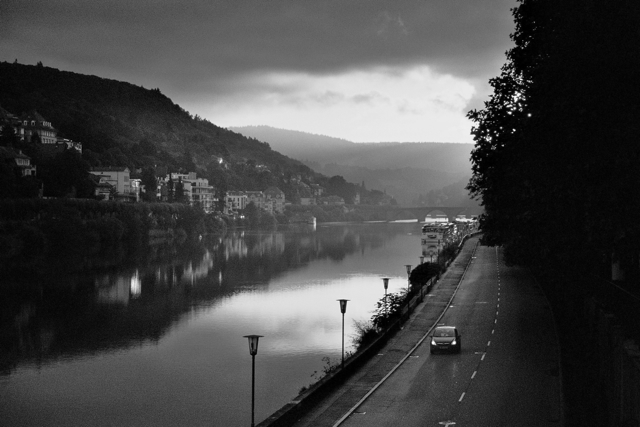
Last week, when Wife was away with the car on a visit to Brussels, I took the 707 to work. The bus passes through Wiesloch, and the daily trip from my stop at Schillerpark to the Industriegebiet via the Bahnhof took about twenty minutes. The connection to the physical world these bus rides forced drew a sharp line of contrast to my usual trips to office, boxed inside a car.

At this time of the year, with a handful of warm days left, life appears to be at its limit: grass has broken through gaps in the pavement concrete; creepers have climbed over walls in a doomed bid to escape; insects everywhere lay claim as first-class citizens of the planet. They all will soon retreat. A faint clatter of hoofs is audible: winter’s cavalry is steadily approaching. The street that leads from my home to Schillerpark has begun to show traces of yellow; on my first walk I found yellowing maple leaves fallen uniformly along the footpath edge, matching the orderliness all around. The trees here are German too.
Continue reading “The bus ride to work”

Onam


Pookalam


This year Wife decided to follow the pookalam ritual during Onam, creating flower-carpets for ten straight days. Every day there was a new layer, appended not to the previous day’s carpet but to a new one laid out with fresh flowers, and on the final day she ended with a ten-ringed pattern. I was assigned the role of petal-plucker: each morning I removed petals from different flowers (whose names I still do not know) and this practice acquired a meditative quality as I went around a flower, detaching the petals, observing for the first time their intricate curls and perfect symmetries, and it led me to believe that one could spend a lifetime observing the beauty of these forms. The petals, collected in bowls, were then picked up by Wife and arranged in circles at our doorstep to welcome, as tradition had it, the king Mahabali.

This simple ritual, repeated for ten days, left Wife feeling bright and chirpy in the mornings. Unlike me she is religious, and when time and circumstance permit she follows customs she learned from her parents. Such rituals, then, are connections to one’s past, one’s childhood; they are also connections to our communities, family and friends, and these days communities have moved online. So the ritual was extended: a photo of the pookalam was taken each day and posted on Facebook; some left generous comments, others were inspired to begin a similar routine.

Continue reading “Onam”

The private and the public


As the date approaches, the world comes together. In the last two weeks I’ve often felt that we all are being manoeuvred towards that point of collective recollection of what happened ten years earlier. All the media – the Radio, the Television, the Internet, the Magazines, the Newspapers, the Posters – conspire to remind us that ten years have passed. The world changed that day, they all say, so spare a thought.

My world did not change that day. I drove to work, returned earlier than usual, watched news on the television more than usual, and slept. I went to work the rest of the week, and the week after. I bought groceries on the weekends, visited the library to borrow books. Life continued, the weight of daily routine pulling me forward in a well-defined orbit, a cycle I had been following since I arrived in Germany. Occasionally I heard of people losing their jobs, but I did not lose mine. I also heard of people being harassed at airports, bring profiled along racial lines; I was asked to remove my shoes, which I did — it was a price I was willing to pay for the safety of crossing the Atlantic. But as I continued to tell myself that my world hadn’t really changed after 9/11, something entered my life, unbeknownst to me, like an odourless gas that enters a room through the crack beneath a door. I had begun to pay attention to the world, to follow events regularly, at first the ones related to 9/11 and later, broadening my field of vision, other world affairs. My distaste for politics had not decreased, but I could no longer ignore its consequences. The public space had entered my private life.

Continue reading “The private and the public”

Departure


[Part six of the Visiting Home series.]

During my last week in Bangalore I visit a government office to pay property tax for a site we own. (Pa usually does this, but this time he thinks I should “get a taste” of Indian bureaucracy too.) It is a small office above a supermarket, a place you wouldn’t notice unless you were looking for it. Inside, a long hall with rows of desks stacked with papers and ledgers, at the end of which there is a cabin and two counters with tiny windows for accepting cash. Large monitors sit unused on some desks, with a dot-matrix printer on the side. Dust is everywhere: on fans, on monitors, on tables with files, on slotted-iron shelves with more files. A framed portrait of Ganesha hangs in a corner, garlanded with flowers, now dry. Employees are chatting unhurriedly. An atmosphere of stasis.

Continue reading “Departure”

The ground beneath my feet

[This began as a comment in response to Beth’s reflections on using our hands. Soon I realized there were a bundle of memories waiting to emerge, and inspired by Dave’s response I decided to write one myself.]


Growing up in India, I spent a lot of time barefoot. School prescribed a uniform that included black leather shoes, but back home I spent the rest of my day wearing nothing on my feet. I wasn’t conscious of this: it was a way of life. The weather – hot and dry most of the year – may have been a reason, but it had more to do with habits that result from watching people around us. These people – our relatives, friends, and neighbours – put on footwear only when they left home, on an errand, for a social event, for work; at home they went barefoot.

I played cricket on a street near home, an unpaved stretch that would turn squishy with mud during the monsoon, and although I wore slippers out of home I took them off during play: it was easier to run barefoot. Sometimes a sharp stone cut my foot, or, when I went searching for the ball in a plot that hadn’t been weeded, a few thorns pricked my soles, but these were part of the game, minor episodes that were soon eclipsed by an action in the match, like a boundary or a wicket. When I returned home with a bruise or a cut I displayed it proudly – it perhaps gave me a sign that I was growing up, capable of bearing pain; then, ignoring all my protests, my mother sat me down and patiently smeared an ointment – Betnovate or Neosporin – on and around the wound, advising me to be more careful next time.

Continue reading “The ground beneath my feet”

Asimov’s psychohistories, Hegel’s histories

[If science fiction is viewed as history in reverse (or as alternate history), what does it reveal about the way history is written and understood?]

The first female character in Isaac Asimov’s Foundation appears in the final third of the book. Licia, wife of the Korellian republic’s leader, is a young woman whose “face was pale and coldly formed” and whose “voice was tart”. She taunts and threatens her husband, invoking her father’s power: “My father would pulverize your toy nation to meteoric dust.” She makes another brief, and similarly insignificant, appearance thirty or so pages later, which marks the end of female presence in this novel that spans a hundred and fifty “Foundation years.”

Rereading a classic can be revealing. I remembered little from my first reading twenty years ago, and on this occasion reading Foundation was like entering a video-game world of men with their politics and guns and trading ships. The sense of place, a vital element for imagining a world vastly different from our own, was all but missing, and the only cultural references included a “vegan” cigar, a two-century old wine, and a game of solitaire. Technology, too, seemed old-fashioned for a world fifty-thousand years in the future: calculators, elevators, public “visiphones” to make calls, “spy beams” to snoop on conversations, “air tubes” between ships, alchemical “transmuters” to convert iron into gold, atomic weapons, identification through a photo-bearing passport, and an encyclopedia containing all human knowledge. The novel was first published in 1953, and the last six decades have turned this view of a future world into an anachronistic vision. A sobering thought, it suggests that predicting the arc of technological progress is harder than we think it is. With our imaginations influenced by extant or emerging technologies, can we conjure up anything that wouldn’t pale half a century later?

Continue reading “Asimov’s psychohistories, Hegel’s histories”