Just let it be, my friend


Sometime in the late Eighties, during my school days in Secunderabad, I watched a movie on television that left a strange impression on my mind. I must have been thirteen or fourteen, a typical Indian teenager fond of cricket, comics and movies. (Girls were only a curiosity, but that would change soon.) Every Sunday I would check the Deccan Chronicle for the scheduled evening movie on Doordarshan, and if it looked interesting I would be home in time for the 5:45 pm “Hindi Feature Film”. There was a Black & White TV at home, an Uptron portable fourteen inch with a V-shaped antenna that stuck out like a pair of bunny ears, and Doordarshan, you’ll remember, was the only channel we received those days.

On this Sunday the movie, Jaane Bhi Do Yaaro, was not one I’d heard of before, and there were no big stars listed either. But the name intrigued me for some reason, so that evening I skipped a game of cricket and settled myself on the sofa at a quarter to six. The next two and half hours had me in splits. I don’t remember laughing so much to a movie before, and since then only Johnny Stecchino, starring the incomparable Roberto Benigni, comes anywhere close. But there was one problem with Jaane Bhi Do Yaaro: I did not understand the ending, which left me sour and confused all evening, and I decided I didn’t like the movie. Next day, at school, I asked my classmates, but no one had cracked the puzzle. Why did the Vinod and Sudhir, dressed as prisoners, make that throat-slitting gesture? Were they to be hanged? Or were they already ghosts, spirits of two innocent men who were hanged, wandering in Bombay like zombies? Why, after all that fun, did the ending need to be so tragic? It simply wasn’t fair!

Continue reading “Just let it be, my friend”

Identity

From the window of my room I could see the workers in an adjacent plot. Sometimes I heard the clink of metal on metal, or the piercing roar of a drill seeking water, and late in the evening there were voices, laughter even, with a rough edge. The men – there were eight or nine of them – started the day early. I woke up to the hum of a generator, and found them at work, extending the foundation, perforating a sheet, mixing cement. They worked in pairs or in threes; I never saw a solitary figure. Who were these people? Where were they from? Where were their families?

These migrant workers figured, as abstractions, in a document I was reading. The government had started a project to give people an identity. Every resident Indian would receive a number, a unique identifier, that led to other benefits. Workers like these could, with this number, open a bank account. Or acquire a loan. It promised access where little, they said, existed today. Identity, reduced to a number, was the foundation for prosperity: get your number, the rest would follow.

The media called it an important step in the nation’s march towards greater progress. There were murmurs of dissent – on privacy, security, and cost issues – but these voices were all but lost in the noise from supporters, and the government was not ruffled: five million people had received their number; over a billion would follow.

Continue reading “Identity”

The review cycle

Dear Teju,

At home we get a few magazines and a newspaper delivered to our mailbox. The Financial Times comes everyday, the New Yorker each Thursday, the Economist the day after, and with Time I never can tell the time – it slips in unnoticed. Each has its particular lens, form and style, but there are commonalities too: political events and book reviews are two themes that cut across these periodicals, and following a thread here often reveals more about the publishing industry than the object under the lens.

For instance, some books are reviewed everywhere. What seems to matter here is the reach of an author’s brand or the publisher’s clout: you either have to be a big name, or have a big label behind your name. So Amitav Ghosh, David Mitchell, Ian McEwan, Kazuo Ishiguro, Michael Ondaatje – they are picked up everywhere. It tells you how closed publishing circles are. Looking at these reviews repeat themselves – over a span of a few weeks or, depending on the publishing cycles across the pond, a few months – I would sometimes ask how a new author from a small publishing firm could break through this barrier. Or even a new author from a well-known publishing firm.

Open City has shown how.

What began with James Wood’s review in the New Yorker this spring ended today with Economist’s article hailing a “surprising new voice in fiction”. In between these parentheses were Time’s reference to Soyinka’s reading list (featuring Open City) and Pankaj Mishra’s tiring pyrotechnics in the FT.

(We also get a copy of the Scientific American each month. If you had slipped in a theory or two on those notorious bedbugs or on the colony collapse disorder, you might just have made it in there too.)

I’ve kept aside the print copies containing these references. Looking at these reviews I sometimes wonder how I would have responded if I had known nothing about the author, if I had come upon review after review praising this narrative of a flâneur in New York. Would it have been a different book for me? I’ll never know, and perhaps it is better that way.

What’s next in the journey? Der Spiegel, perhaps, once the German edition is out? And after Europe it will reach the Indian shores. I’ll be watching.

Parmanu

No place like home


Returning after my U.S. trip, I spent the day at home, rediscovering familiar sights (the bookshelf, the balcony, and in the distance the line of trees, the church spires, the helmet-shaped cottages), sounds (silence, interrupted every so often by a car or a bus passing by, and the call of birds whose names I know nothing of), and smells (the bath towel’s lemony scent, and the lavender of wife’s hair). In the evening, as the sun went down behind the woods, on an impulse I picked up the car keys and took off on a drive. The road signs were recognizable, reassuring, and the slow pace – of automobiles, and of people – bespoke a rhythm of life I’d missed while I was away. On my way back, driving through the darkness (which felt intimate in a strange way), I stumbled upon a radio channel playing Mahler’s ninth, which was followed by an elegy by Elgar; I hadn’t listened to classical music for weeks, and I felt like a parched traveler in a desert who had just dived into a clear lake under a full moon.

Next morning, the good old routine: SWR2 on the Radio, Nescafe Gold instant coffee, Financial Times, (White) bread- (Salted) butter- (Pineapple) jam.

Familiarity is soothing, and the daily routine brings back a much-needed sense of control. The adventure and randomness of travel may be thrilling, but I need the stasis and sameness of home to regain my moorings. There really is no place like home.

Deliverance

[After Arrival, Progress, and Curiosity, this is the fourth installment in the ‘Visiting Home’ series. The narrator, an Indian living abroad, is on a visit to Bangalore, discovering and interpreting facets of life in the city and at home.]


The days passed quickly. I woke up late each morning, completed my exercises, and settled down to read English, August after a heavy breakfast under Ma’s watchful eyes, quick to notice my empty plate, and her nimble hands, ready to refill it with another helping of uppitu or akki rotti or idli. Friends I intended to meet were at work all day, so I spent the afternoons indoors, reading, writing, and scanning the irregular Bangalore skyline through the window of my room, avoiding the heat outside.

The only birds I saw were kites, circling above crowded tenements in search of prey, and pigeons, lodged on apartment windows. A pair of pigeons had nested outside my window, and the two eggs I’d seen on the first day had morphed into small yellow creatures that barely moved. I had taken to watching over their growth, returning many times each day to check for progress. The chicks, soft lumps of flesh with yellow hair, tiny grey beaks and dark slits for eyes, could both fit into my palm, but I did not try and pick them up. Three or four pigeons were always perched nearby, like relatives who had come by with compliments for a newly born.
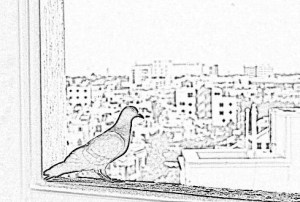
The pigeons piqued my curiosity, so on a hot afternoon I put down my book and looked up the Internet to find out more. The technique beneath a pigeon’s homing instinct, an unsolved riddle when I last read on this subject a decade ago, was (Wikipedia said) still an open matter. One theory pointed to the pigeon’s ability to detect Earth’s magnetic field, another more recent finding suggested an orientation facility based on environmental odors, and yet another fell back on the conventional notion of visual clues in the landscape. The mystery had not affected the pigeon’s role in delivery: until as recently as 2002, when India’s Police Pigeon Service in Orissa had been shut down due to rising costs and competition from the Internet, pigeons had been used to deliver messages; there was even a method, blandly termed ‘IP over Avian Carriers’, to transmit Internet messages using pigeons.

In the middle of this brief exploration my thoughts began to wander. Do pigeons know exile? Are there deserter pigeons – ones that leave home never to return? Can a pigeon have two homes?

The heat soon got to me and I decided to take a nap. When Ma woke me up, she reminded me, gently, that the driver would soon be here. What driver? I asked, still half-asleep, but then I remembered: I had to visit Janaki dodamma that afternoon. I had put off visiting relatives for a while, but Ma had been persistent and I finally relented. I couldn’t drive by himself (Not in this chaos, Ma! I’d said), so a driver had been called for the afternoon.

The driver was half an hour late and offered no explanation for the delay. I did not bother to ask. He was a thin, young man in a crisp navy blue shirt, black pants, polished shoes, and his oily hair was combed flat. With a tie, he could pass for a salesman. He bowed slightly as he collected the keys, a mannerism that indicated years of habit. Traffic was moderate. I spotted a few new brands – Chevrolet, Skoda – but the big names were missing.

What about Audis and BMWs? I don’t see any of those on the road, I asked the driver in Kannada.

Those are rarely seen on weekdays, sir, the driver replied, in a loud and confident voice that belied his quiet manner until then. You’ll see them on weekends when the traffic is less. And many of them will be driven by owners.

Have you driven any? I asked.

Yes sir, he replied, turning towards me. When I was a full-time driver, my owner had a fleet of cars. I drove a Bentley, a Mercedes and a BMW.

Bentley? I was surprised. Why did you leave?

Full-time job has no flexibility, sir, he said. I have to go at times decided by the owner. In this job I can decide when to take up something.

Continue reading “Deliverance”

The Thousand Autumns


In 1542, a Chinese pirate ship was swept by a typhoon towards the island of Tanegashima in Japan. On the ship were a few Portuguese sailors, the first Europeans to land on Japan, who returned to Europe with stories of a united nation with people who had treated them well. Soon Portugal sent its first trading ship, and for the next hundred years the Portuguese had a virtual monopoly on European trade with Japan.

Continue reading “The Thousand Autumns”

Curiosity

[Part three of the ‘Visiting Home‘ series. To read this as an independent piece, here’s some context: the narrator, an Indian living abroad, is on a visit to Bangalore.]

A few days into my visit, Mr.Aloknath – Pa’s friend and business associate – came home. I remembered Mr.Aloknath from my school days in Ranchi. He would visit us now and then, saying he was just “passing by” and had “dropped in to say hello”. The circumstance of this visit was not dissimilar: he was in Bangalore for a few days, and Pa had invited him home to tea.

You’ve grown taller, young man! Mr.Aloknath said, as we shook hands. It was a response I had frequently drawn from relatives on yearly visits to Bangalore as a child, and listening to it now, well into the thirties, made me laugh.

Mr.Aloknath, a short, round, dark man, sported an acrobatic greying moustache that almost touched his white sideburns, a style that had the curious effect of making him look like a tribal with a painted face. Over tea he enquired about several matters, mostly trivial, and offered his opinion on each. The monotonous drone of his sentences brought to mind my college English teacher Mr.Pundit who, in a Shakespeare class, displayed a remarkable constancy of tone that made Caesar, Cassius, Brutus and Casca all seem like one character. I kept up appearances, answering politely, with minimum effort. Sooner or later I expected the inevitable question.

Continue reading “Curiosity”