1. Flowers you pick yourselves, and pay for without fail
 Straddling the border between France and Germany, the fortress town of Belfort is unremarkable save for a large sculpture – by Frédéric Bartholdi, designer of the Statue of Liberty – of a lion carved into the cliff that forms a natural wall of the fortress. The lion, its head reared up in pride, is more striking at night, when artificial lights accentuate the lines and contours and the figure seems to emerge, in triumph, out of the cliff. But this star attraction is all but ignored by the fifty thousand or so people who visit the town each year in May, during the three days it hosts FIMU: Festival International de Musique Universitaire. Continue reading “Notes from a music festival”
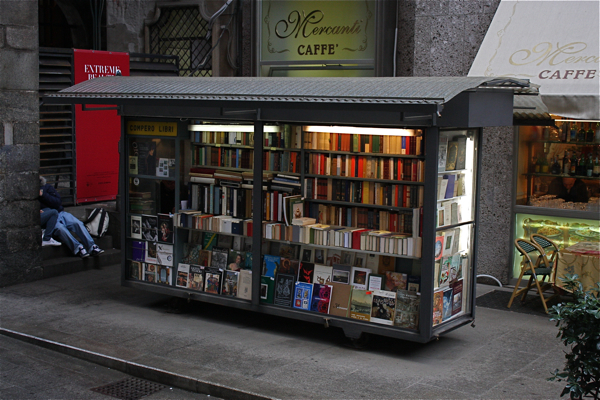
There was a small English bookshop next to the hotel we were staying at in Milan. On the evening of our second day, after a round of shopping and walking in the city, I decided to visit the shop. When I entered I found two old men talking in loud voices. There was no one else around, and seeing me the younger of the two stood up: “How can I help you?” Continue reading “A Weekend in Milan”
Does happiness go around in pairs?
Sifting through the pictures of a recent weekend in Brussels, I find that images with pairs seem to radiate contentment and joy …
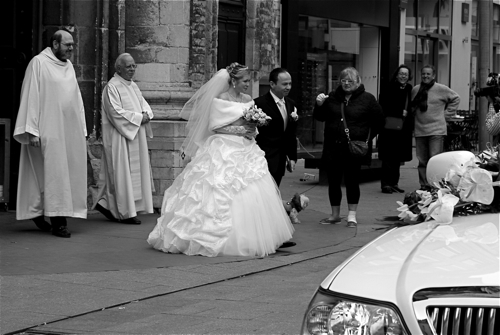
The Brussels skyline is shrouded in mist. Tall buildings in the distance appear as hazy outlines, as if a film of translucent paper was covering a photograph in a book. It has been drizzling on and off through the day, with temperatures bordering 15 degrees celcius and the wind chill making it seem like winter. Mom and dad are taking things bravely: they managed a few hours outside with just a thin sweater on. Continue reading “Diary of a visit”

Photography habits change a lot once you shift from film to digital cameras. One aspect that keeps nagging me is the smaller amount of time I spend with each image, given the large number of pictures I end up taking with a digital camera. I often want to slow down, spend time reflecting over an image, understand the layers within.
One way to do that is to engage in a daily ritual that makes you spend some time with your photographs. So when WordPress recently announced their photoblogging theme, I saw an opportunity there. In the last couple of weeks I’ve posted regularly on my new photoblog. The photo’s aren’t necessarily taken in the recent past – some of them are old, some very recent, and the idea is to spend time with each and in the process learn more about my tastes, strengths, weaknesses.
The theme itself is very interesting:
Imagine a theme for photoblogging where every page looks like it was designed to match the picture. Monotone is a chameleon, it does sophisticated analysis of the image you upload to determine a complementary color scheme. The width of the page also changes based on the width of the photo.
What this leads to is a curiosity about how the chosen photo will turn out in the final published form – what the background will be, and how it will complement (or contrast with) the photo. I’ve been very satisfied with the results so far, and I hope to engage regularly in this activity.
When I first saw Joakim he was sitting in front of his cottage, plucking blades of grass with one hand and holding a thick book in another. His long, golden hair, Scandinavian features and relaxed but alert posture set him apart from the other pot-smoking foreigners I had seen so far at the guest house. The next morning I saw him walking towards the sit-out with a cup of tea and a book with letters “Idioten” printed on the front cover. It was still early, and the sit-out – with mattresses on the floor and tables made of low granite slabs, full of activity in the evenings with foreigners smoking, drinking or passed out – was empty. I followed him with my cup of tea.
Joakim was Swedish – “Idioten” was a Swedish translation of Dostoevsky’s “The Idiot”, and due to the similarities between Russian and Swedish, Joakim explained later, the translation retained the richness of prose in the original. He had been in India a couple of months now and intended to stay on until March. He liked taking long vacations in foreign lands; the last time he was in India in 2004, he spent six months touring the north of the country. He worked in the health-care industry, with autistic children; his main job was to help those children – talented in their own way – get through the day without much stress; it was hard work, but very satisfying. Hampi was interesting, beautiful. It was also inexpensive. He’d been here for a week, and intended to stay a few more before moving towards Goa.
Our guest house was in a small village next to the Tungabhadra river, on the bank opposite Hampi. The street, full of similar guest houses, was teeming with foreigners – most of them young, like Joakim, in their twenties or early thirties (A guide-book referred to them as “modern hippies”). The local economy had moulded itself around this clientele: there were small shops stocked with global brands, Internet centers, restaurants offering cuisines from all over the world, and perhaps most important of all, the place was safe: young women wearing tank-tops walked alone at night on that poorly-lit street.
This was a side of Hampi that I had least expected, but it wasn’t altogether surprising. Hampi is a destination that invites slow exploration, and it seemed natural that an ecosystem that supported this pace had sprung up. Days spent walking the ruins spread over miles of rocky terrain could be interspersed with others spent lying on a hammock watching egrets gather in the fields next to your cottage or smoking pot with friends, depending on your disposition.
We spent two and half days at the guest house, crossing over to Hampi each day to cover what little was possible with the time on our hands. An essence of what we saw is collected here : Photo Essay – Hampi
 Parmanu