Rashomon

Heidelberg


The other morning, there was an incident on the tram. A hundred meters from the Hauptbahnhof stop, where streams of passengers bound for another city pour out each day, the tram stopped. Through the driver’s cabin I saw a bus blocking our way. We waited for the bus to move. It didn’t. Minutes passed. A tram went by in the other direction, then a bus. Our driver, a woman with short golden hair, spoke with the driver of this passing bus. Then she left her cabin and walked through the tram’s length, passing word that the bus ahead had stalled due to a problem. We had to return to the previous stop. Some passengers sighed, looked at their watches. A woman standing near me said, in a distressed voice: Lass mich aussteigen! — Let me get down! I have a train to catch! But the driver had moved on. She entered the cabin at the other end, and the tram began its journey to Stadtwerke, the stop we had passed a while ago.

The woman’s agitation grew. Where is this going! Why can’t they let me out? The others sat unmoving, unmoved. No one commiserated with her, nobody vented their own frustration. The woman, middle-aged, in a yellow overcoat, clutching a black suitcase, remained the sole campaigner.

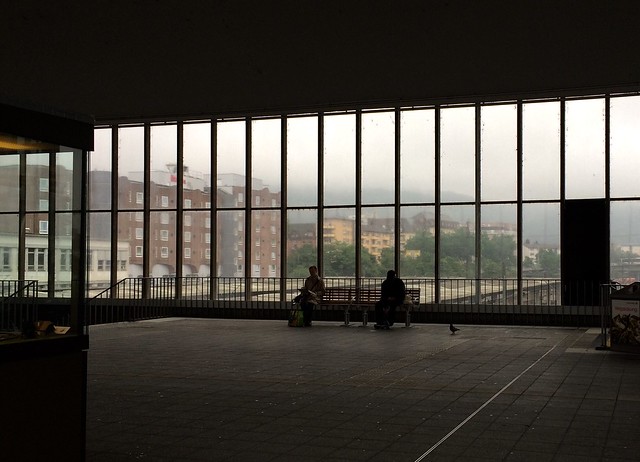
It was a rainy morning. On the street umbrellas glided past, sprinkling much-needed colour to this unseasonal grey summer day. The tram windows framed blurry outlines of stately old buildings and misty hills in the distance.

Some minutes later the driver trotted back across the tram, toward the original cabin. The woman asked again to be let out.

I can’t do that, the driver replied firmly. I’m not allowed to!

I’m going to miss my train! the woman cried. Can’t you see that? She followed the driver to her cabin, wheeling the suitcase.

We are in between two stops — I can’t let you out! The driver stepped into her cabin and shut the door.

I’m going to miss the train! I have an important business meeting! Who’s going to pay for the damages? You? Why can’t you simply let me out? You have no right to hold me in here!

The rest of us looked on, like members of an audience watching a drama unfold on stage. No one shared this woman’s urgency, but her persistence got the driver to yield. She asked the woman to get off the tram from the small door inside her cabin.

And this is at your own risk! It’s not my fault if you get injured!

Yes, yes — I do it at my own risk.

The woman hopped across the track onto the road, with her suitcase in tow. Then the tram lurched forward, swiftly gaining speed, and half a minute later we were at the Hauptbahnhof. A man sitting nearby clicked his tongue: If she had waited, she’d probably have reached the station earlier.

We carried home a story that day, the woman, the driver, and the rest of us. Each a different story.

Hex River Valley and the stolen grapes

Shrubland_film
[ The fifth and final installment in the South Africa series. The others, in sequence: Cape Town Weekend, Clanwilliam and the rock art trail, Tankwa Karoo and the CIA plot, Sutherland and the moons of Jupiter. ]


Cape Town is four hours by car from Sutherland. The entire stretch was paved, and in the first hour and half, on the R354, the rolling shrubland I’d seen the day before continued. The road was deserted. Moderate traffic appeared on the N1, a single-lane highway where trucks made way for faster vehicles by shifting half their bulk onto the shoulder. The vehicle that passed always turned on its left and right indicators: a gesture of gratitude to the truck now in its wake. The discipline and manners were European, a pleasant surprise.

This was still high country, fifteen hundred meters above sea level. When road began to descend, following a short pass, the scene ahead took my breath away. Set in a narrow gap between two rows of barren and rugged mountains was the greenest valley one could imagine. The transformation was unusual, startling. Beginning at the foot of the desolate mountains, row after row of grapevines filled the entire valley, a pattern broken occasionally by a white barn standing out from the green carpet. A slim line of water shimmered in the sun, and groves of trees wove patches a darker shade of green. It was a stunning aerial prospect, and after several days in the colourless desert I felt the emotion of a weary traveler stumbling upon a vast green oasis.

Continue reading “Hex River Valley and the stolen grapes”

Sutherland and the moons of Jupiter


South Africa


[ Part 4 of the South Africa series that began with Cape Town Weekend, continued in Clanwilliam, and had last stopped at Tankwa Karoo. ]


In Cape Town and later, when I spoke of my plan to visit Sutherland, eyes always lit up. It was a place most wanted to visit but few had, and their pupils revealed something of the reputation the town carried. I knew nothing of this character when I included it in my itinerary, relying solely on town’s proximity to the South African Large Telescope (SALT), “the largest single optical telescope in the southern hemisphere”, where visitors on a guided tour look through the instrument’s eye at the night sky. I planned one night in Sutherland, and prayed silently for a clear sky.

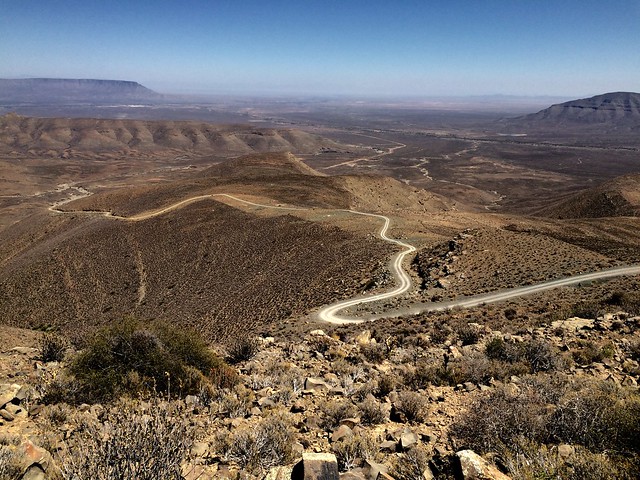
The sky was clear when I left Gannaga Lodge on Thursday morning. The evening before, Johann had suggested I follow the Ouberg Pass to Sutherland: this route was more difficult, he said, but the scenery was spectacular. At breakfast that morning Louis had seconded this view, and he gave me directions to get on the route. Following the Gannaga pass into the veld I had crossed the previous day, I turned east after the park office. The gravel track curved toward another arm of the Roggeveld mountains, and soon the track turned narrow and steep. I drove slowly, halting, at one bend, to watch a small pack of springboks saunter downhill.

Continue reading “Sutherland and the moons of Jupiter”